


Discover Laos — Complete Guide by Asia Safari, Local Agency in Vientiane
Laos is one of the last Southeast Asian countries to have preserved its soul. Between dense jungle, the lazy Mekong, Buddhist temples, and ethnic villages, the “Land of a Million Elephants” offers a unique travel experience — far from the crowds, close to the essentials. This complete guide is written by the Asia Safari team, based in Vientiane since 2002.
Laos is not a mass tourism destination. Its ambition is sustainable tourism, and it has a reputation for having turned its back on the frantic globalization at work in neighboring countries. The trade-off for this smiling authenticity is accepting a degree of unpredictability. With only 7 million inhabitants, half that of Bangkok, Vientiane, the capital, feels like a small town on the Mekong. One is quickly charmed by its human scale, its wide French-style avenues, its fountains, and its traffic lights. The hotels have a colonial whiteness, the gardens are a deep green, and the golden stupas gleam under the sun.
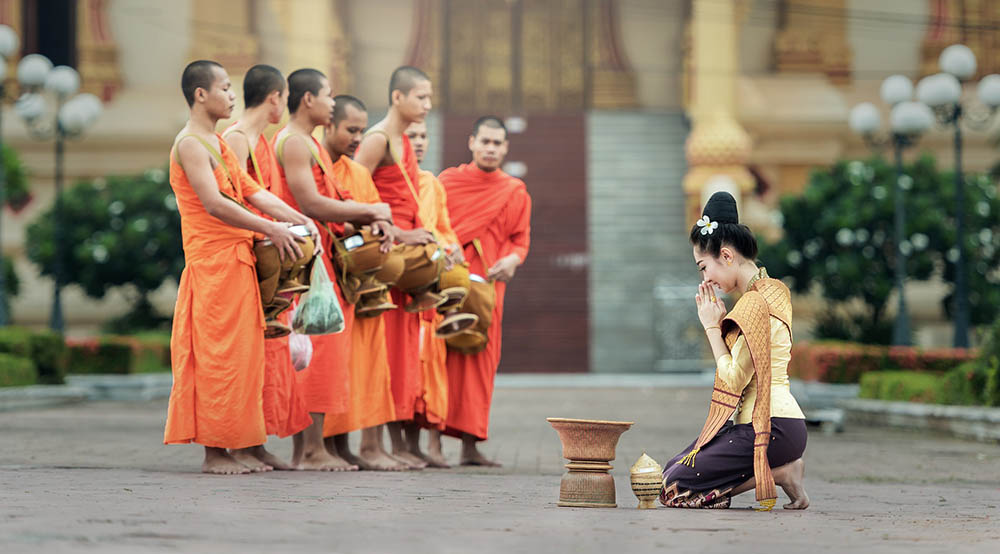
Throughout the country, you interact with a population that greets strangers with a “Sabaïdee” hello that is always cordial, joyful, and most often disinterested. Spirituality, very present in Luang Prabang, has spread throughout the country, including in the remote lands of northern Laos where many ethnic minorities live. High up on the peaks, animist rites harmoniously coexist with Buddhism, represented in the villages at the bottom of the valleys. In total, more than 60 ethnic groups coexist in this small country, on the fringes of classic tourism.

History of Laos, the Land of a Million Elephants
Laos remains to this day the least known country in Southeast Asia. It is also marginal and somewhat enigmatic: the 250 jars of the Plain of Jars, carved from monolithic blocks, puzzle experts who have been unable to precisely date these ancient remains attributed to the first half of the 1st millennium BC. The penetration of Hinduism and Buddhism into the south of present-day Laos is attributed to the Chams and Khmers. In the 13th century, Buddhism supplanted Hinduism in Southeast Asia, and the Lao prince Fa Ngum was raised at the court of the Khmer sovereigns. He founded the largest kingdom in Southeast Asia, Lan Xang Hom Khao, and seized Luang Prabang, which became the first spiritual, political, and administrative city of the kingdom of a Million Elephants. In 1550, Vientiane, founded by King Photisarath, became the capital of the kingdom. Vientiane and Champassak were annexed by Siam in 1768, and only Luang Prabang maintained Lao sovereignty until the 19th century.
In 1893, France imposed on Siam the recognition of its protectorate over Laos, which was integrated into Indochina, becoming a province. King Sisavang Vong remained on his throne, with the French presence being primarily administrative. The schools of the Republic educated Laotians in French culture and practices. Temples maintained traditional education in the Lao language. The colonial administration mandated road construction. With World War II, France’s prestige collapsed, and on April 8, 1945, independence was proclaimed under Japanese pressure. In 1947, a Laotian constitutional monarchy was formalized within the framework of the French Union. Following the Geneva Accords of 1954, the French returned full sovereignty of their country to the Lao. Adding sixty years of protectorate to twenty years of strong French cultural presence, eighty years of relatively strong ties unite France and Laos.
Follow our adventures
Subscribe to the Newsletter
Subscribe to our newsletter to receive all our travel news.
Why choose Asia Safari for your trip to Laos?
With Asia Safari, you plan your tailor-made trip directly with a local English-speaking team. Our agency has been based in Vientiane since 2002. Its founder, Jean-Paul Duvergé, has worked in Laos since 2000. Our guides are Lao, our accommodations are hand-picked, and each itinerary is tailor-made. The result: a vibrant, fair trip, without unnecessary frills.
- Local English-speaking agency: we speak your language and know the country from the inside
- Zero intermediaries: you deal directly with the local team
- Truly tailor-made: no fixed catalog — each trip is unique
- Since 2002, Asia Safari has been creating tailor-made journeys in Laos, drawing on the experience its founder has gained in the country since 2000.
How does our tailor-made service work?
1. You send us your request (dates, budget, desires, profile)
2. We send you an initial response within 24 working hours, followed by a detailed proposal within 48 working hours of receiving the necessary information: your itinerary, accommodation and a quote specifying the services included.
3. We refine the proposal together, adjusting the itinerary, accommodation and activities to suit your expectations and budget.
4. We coordinate the services included in your itinerary on the ground: guides, transport, accommodation and activities.
When to visit Laos?
From November to February, the weather is generally drier and temperatures are milder. March and April are often hotter. The rainy season, from May to October, brings lush green landscapes; we adapt the itinerary and transport to local conditions.
Laos, the heart of your Indochina tour
Laos is often the surprise of a trip: uncrowded, authentic, with a quiet beauty. Asia Safari makes Laos much more than a stopover — we make it the central experience of your stay, before or after Vietnam, Cambodia, or Thailand.
Our travel ideas for Laos and neighbouring countries
Laos + Cambodia: from the temples of Luang Prabang to Angkor, shape a journey combining cultural heritage and Mekong scenery. A visit to Tonlé Sap can complement the itinerary, depending on your interests and the time available.
Laos + Vietnam: Two contrasting countries — the calm of Laos and the energy of Vietnam. From Hanoi to Vientiane or vice versa.
Northern Laos + Yunnan: from the landscapes of Yunnan to the mountains of northern Laos, the Laos–China railway can connect some of the stops on your journey. We plan the route with you, in either direction.
Grand Indochina Tour (40 days): Laos, Vietnam, Cambodia, Thailand — a memorable trip for life.
Tips for preparing your multi-country tour
Visas: each country has its own rules — Asia Safari guides you through all procedures.
Duration: we adapt the number of stops to the time you have available. For a trip combining two countries, we consider the regions you want to explore, travel between destinations and your preferred pace.
Seasons: seasons vary by country — we help you choose the best window.
Budget: the cost of a multi-country trip depends on its length, the season, the number of travellers, accommodation and transport between destinations. We prepare a personalised quote specifying the services included and any expenses to budget for separately.
Our Story
Jean-Paul Duvergé has worked in Laos since 2000. In 2002, he founded Asia Safari in Vientiane to design tailor-made trips in Laos and Indochina. Today, the agency’s French-Lao team plans each itinerary with its travellers and coordinates arrangements on the ground with its local guides and partners.
What sets us apart
A team on the ground: based in Vientiane, we plan your trip using our knowledge of Laos and information from our local partners. We take the seasons, travel conditions and accommodation into account when designing your itinerary.
We speak your language: our team supports you in English, from planning your trip to assistance during your stay. English-speaking guided visits are arranged according to your itinerary.
Direct contact with our team: you speak with the people who plan your trip and coordinate its organisation on the ground. Your quote specifies the price of your trip and the services included.
Tailor-made journeys: our suggested itineraries are starting points. We adapt the destinations, pace, accommodation and activities to your dates, wishes and budget.
Our commitment
We give preference to local accommodation providers and partners. When visiting villages, we take care to respect residents and their customs. Our approach also aims to help preserve the cultural and natural sites that make Laos special.
Laos in figures
Laos covers 236,800 km² and had a population of around 7.9 million in 2025. Its capital is Vientiane, its official language is Lao and its currency is the Lao kip (LAK). Theravada Buddhism is the main religion. The country is in the UTC+7 time zone.
Laos must-sees
Luang Prabang: Former royal capital, a UNESCO World Heritage site, its golden temples, French colonial houses, and gentle way of life make it an undeniable favorite.
Vientiane: The human-sized capital — That Luang, Patuxai, and the banks of the Mekong are worth a visit.
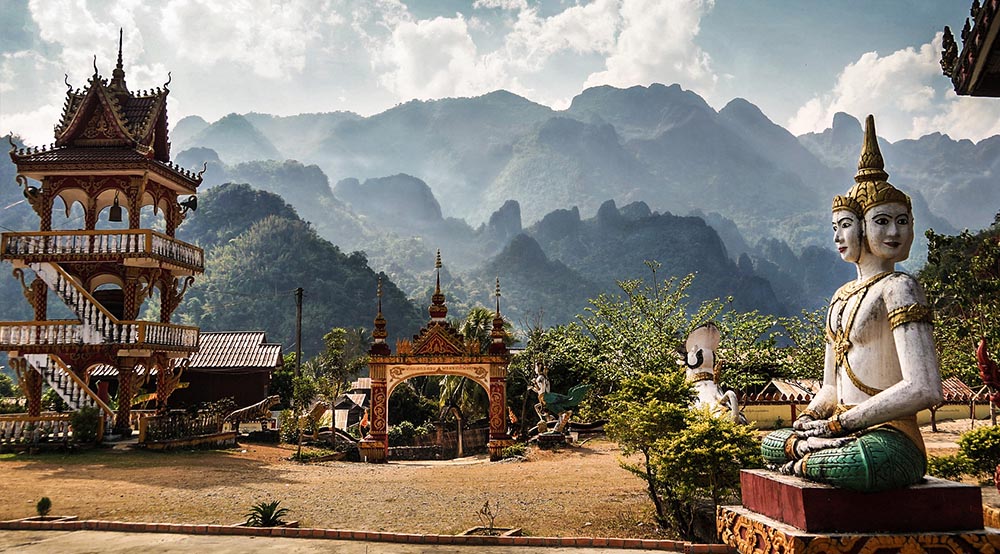
Vang Vieng: Surrounded by limestone karsts, ideal for kayaking, caving, and hiking.
Southern Laos and 4000 Islands: Champassak, the Vat Phou temples (UNESCO), the Bolaven Plateau, and the Mekong islands.
Lao culture
Theravada Buddhism has an important place in Laos, alongside a variety of cultural traditions. In Luang Prabang, the monks’ morning alms round is a religious ritual to observe with discretion and respect. Boun Pi Mai, Lao New Year in April, and Boun Ok Phansa, which marks the end of the Buddhist rains retreat, are among the events that shape the year.
Nature and biodiversity
The forests and protected areas of Laos are home to a variety of wildlife, including Asian elephants, gibbons and sun bears. Rivers, mountains and plateaus offer many opportunities to explore nature.

