

From August onwards we get the same message every year: “We have three weeks this winter — can we do Laos and Cambodia together?” The answer is yes, and it is one of the easiest two-country trips in Southeast Asia. The two countries share a border, the crossing takes a morning, and the dry season arrives at the same time on both sides of the Mekong. What is left to decide is the direction, the route and the paperwork. Here is what we tell travellers from our office in Vientiane.
Why Laos and Cambodia work so well together
Both are Mekong countries, both are Theravada Buddhist — and yet they make for two very different journeys. Laos moves slowly: riverside villages, morning markets, wooden temples you enter barefoot and often alone. Cambodia delivers the visual shock — Angkor, its sandstone towers and strangler-fig roots, the largest pre-industrial city ever built.
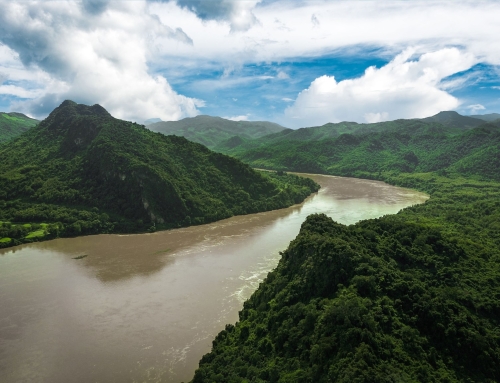
The link is geographical too. The Mekong runs from northern Laos all the way to the delta, and the Four Thousand Islands sit barely sixty kilometres from the border post. Reaching Cambodia is not a detour; it is simply following the river downstream.
There is also a question of pace. Starting in Laos gives you time to slow down and to enjoy days without a schedule. By the time Angkor arrives, you are ready for it. Done the other way round, Laos can feel “quiet” — which is precisely its quality, but one you appreciate more once you have already slowed down.
When to go: the November to February window
The good news is that both countries share the same calendar. The dry season settles in around November and holds until February: clear skies, 25 to 30 °C during the day, and genuinely cool nights in Luang Prabang and on the Bolaven Plateau. Bring a fleece — travellers mention it to us every year.
From March to May the heat builds sharply in southern Laos and over Angkor, and northern Laos gets a haze from agricultural burning in March and April that closes off the views. From June to October comes the green season: the rice terraces are at their best and the Khone Phapheng falls reach full power in August and September, but some southern back roads become difficult and boat transfers depend on river levels.
Our own preference is November and early December: everything is still green from the monsoon, and the sky is already dry. One practical note — for a Christmas or New Year departure, book four to six months ahead, because the best addresses in Luang Prabang and Siem Reap fill up early. Our guide to the best time to visit Laos breaks the seasons down region by region.
Our 15-day route, from Luang Prabang to Angkor
Days 1 to 5 — Luang Prabang and the north
Fly into Luang Prabang, the former royal capital and a UNESCO World Heritage site. Three days cover it well: the morning alms giving, Wat Xieng Thong, Mount Phousi at sunset, the Kuang Si waterfalls and a day among the villages along the Nam Khan river. Two extra nights allow a run up to Nong Khiaw and its limestone cliffs.
Days 6 to 9 — Vientiane, Pakse and the south
Head south to Vientiane, now two hours away on the Laos-China Railway, then take a domestic flight to Pakse. The south looks nothing like the north: the Bolaven Plateau and its coffee estates, the Khmer sanctuary of Wat Phou — the country’s other UNESCO site, and a perfect warm-up for Angkor — and then the Four Thousand Islands, where the Mekong spreads fourteen kilometres wide. This stretch is the heart of our Southern Laos must-sees tour, over 6 days.
Days 10 to 15 — Cambodia
Cross the border in the morning, stop at Kratie for the Mekong dolphins, then continue to Phnom Penh and finally Siem Reap, with three full days at Angkor — the grand circuit, the Bayon, Ta Prohm and, for early risers, Banteay Srei at opening time.
That sequence matches our Essentials of Laos and Cambodia tour, over 15 days. If you only have a week, the short version exists: From Southern Laos to the Temples of Angkor covers the core in 8 days, starting straight from Pakse.
The Nong Nok Khiene border, in practice
Visas, in the right order
This is where most plans come unstuck, and it comes down to one sentence: the Lao e-visa is not valid at the Cambodian border post. The official portal, laoevisa.gov.la, accepts it only at the three international airports (Vientiane, Luang Prabang, Pakse), at Friendship Bridges I, II and IV with Thailand, at Boten on the Chinese border, and at the Boten and Khamsavath railway stations.
Hence the order we recommend: fly into Laos, leave overland to the south. All you then need is a Cambodian visa on entry at Trapeang Kriel. Cambodia’s official e-visa — evisa.gov.kh, and only that site, as many intermediaries add a fee — is accepted there, and visa on arrival is available too. We suggest the e-visa: it removes any discussion at the counter.
The post is open daily, roughly 7am to 5pm. Carry small US dollar notes: modest, unofficial stamp fees are commonly asked for on both sides. It is settled in two minutes and without drama. Since these rules do change, always confirm your entry point on the official portals before paying anything.
Overland or by air?
From Nakasang, the pier for the Four Thousand Islands, the border is about ninety minutes away by shared taxi. On the Cambodian side, Stung Treng is 57 kilometres further on, and Kratie roughly two hours by bus. It is a straightforward, well-travelled route — but it takes a full day.
There is an alternative: Lao Airlines connects Pakse to Siem Reap-Angkor in under an hour, with a few rotations a week. Flight days shift with the season, so they need checking as the trip is built — which is exactly what we do for our travellers.
Our advice: go overland if you want Kratie and the Cambodian Mekong; fly if your calendar is tight and you would rather give that day to Angkor.
Three questions we are often asked
Can you still see Irrawaddy dolphins from Don Khone? No — and we would rather say so before departure than after. The last dolphin in the transboundary pool died in February 2022, and the species is now gone from Lao waters. Around ninety remain in Cambodia along a 180-kilometre stretch of the Mekong, and they are watched from Kampi, near Kratie — which is right on the route of this trip.
What is the minimum length? Fifteen days to do both countries without rushing. Below that, drop northern Laos and concentrate on the Lao south and Angkor, in around twelve days.
What if we want more? Some travellers want to add Vietnam or Thailand. It is possible, but it takes time: our Grand Tour of the Indochinese Kingdoms covers the whole region in 40 days.
Let’s build your itinerary
A Laos-Cambodia trip is won or lost on details: the direction of travel, the day you cross the border, a well-placed domestic flight, one more night in Luang Prabang rather than Phnom Penh. We are based in Vientiane, we run both routes all year round, and we shape every programme around the pace of the people travelling.
Tell us about your plans — send us your dates and how much time you have, and we will come back with a tailor-made itinerary.