

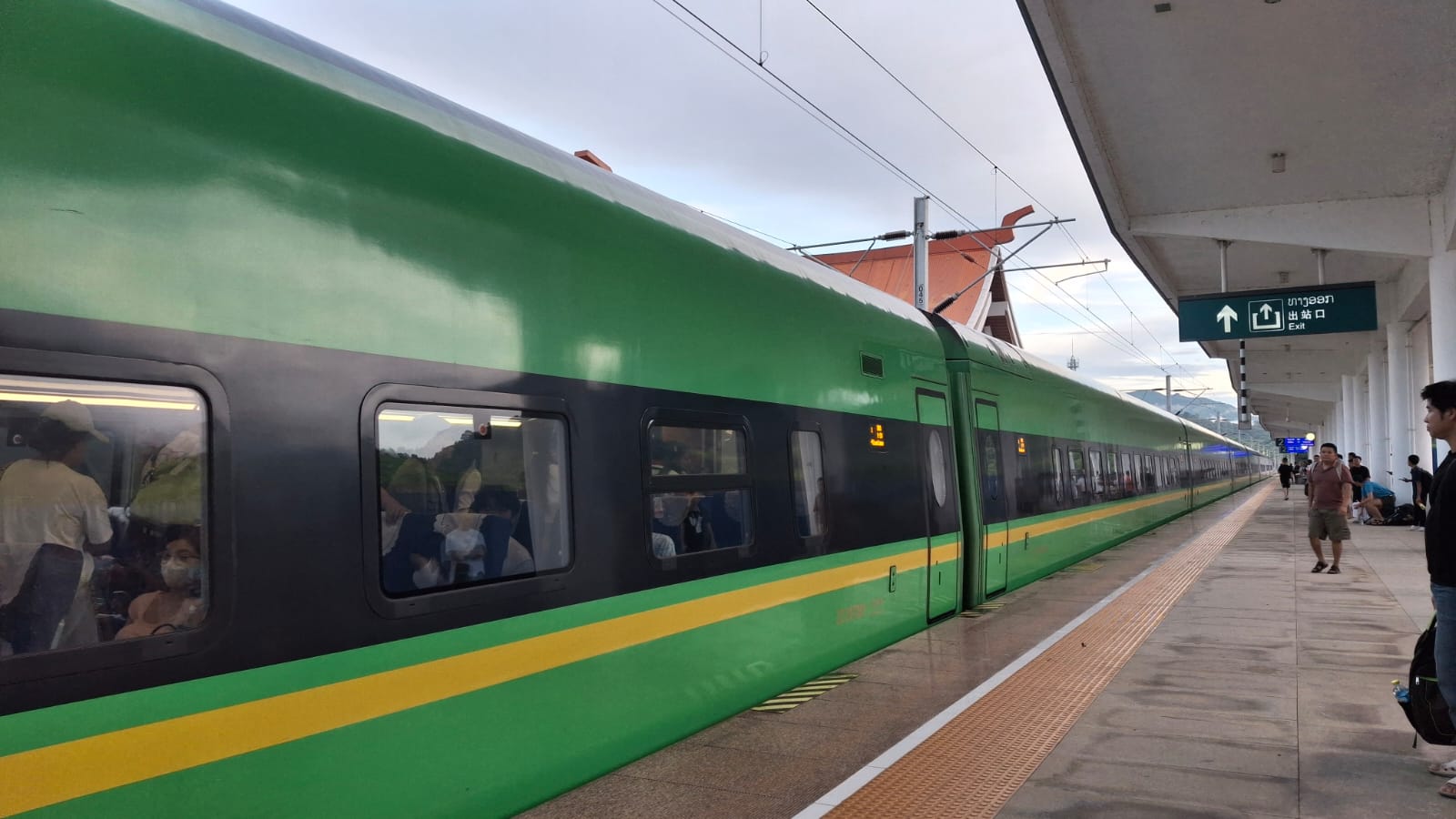
Not so long ago, getting from Vientiane to Luang Prabang meant ten to twelve hours on a winding mountain road, motion sickness included, arriving after dark. Since the Laos-China Railway opened, the same journey takes under two hours. It is probably the single biggest change to travel in Laos in twenty years.
Modern as it is, though, this train is not booked like a European high-speed service. Tickets go on sale late, stations sit well outside the towns, and security confiscates things you would never think about. Here is what we explain to our travellers every week, from our office in Vientiane.
The Laos-China Railway at a glance
The line runs from Vientiane to Boten on the Chinese border, roughly 420 kilometres, continuing on to Kunming on the Chinese side. It cuts straight through the mountainous heart of the country: more than half the route is in tunnels or on viaducts, and the open stretches offer superb views over karst peaks and rice fields.
The stations that matter
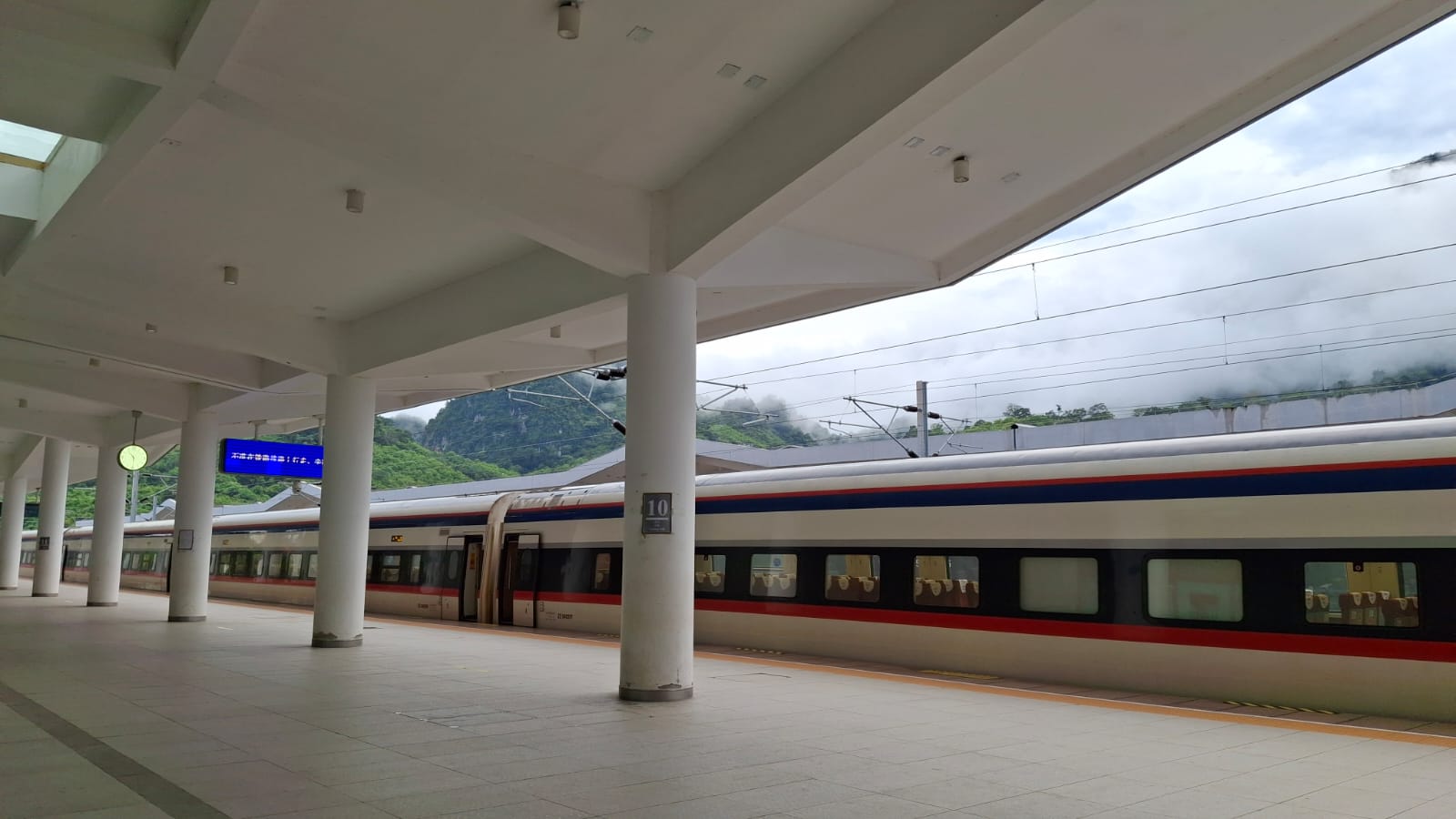
- Vientiane Capital — the main high-speed station, north of the city.
- Vang Vieng — the most convenient of the five, just a few kilometres from town.
- Luang Prabang — about twelve kilometres from the old town.
- Muang Xay (Oudomxay) — the gateway to the far north.
- Boten — the border crossing into China.
On board the Lane Xang
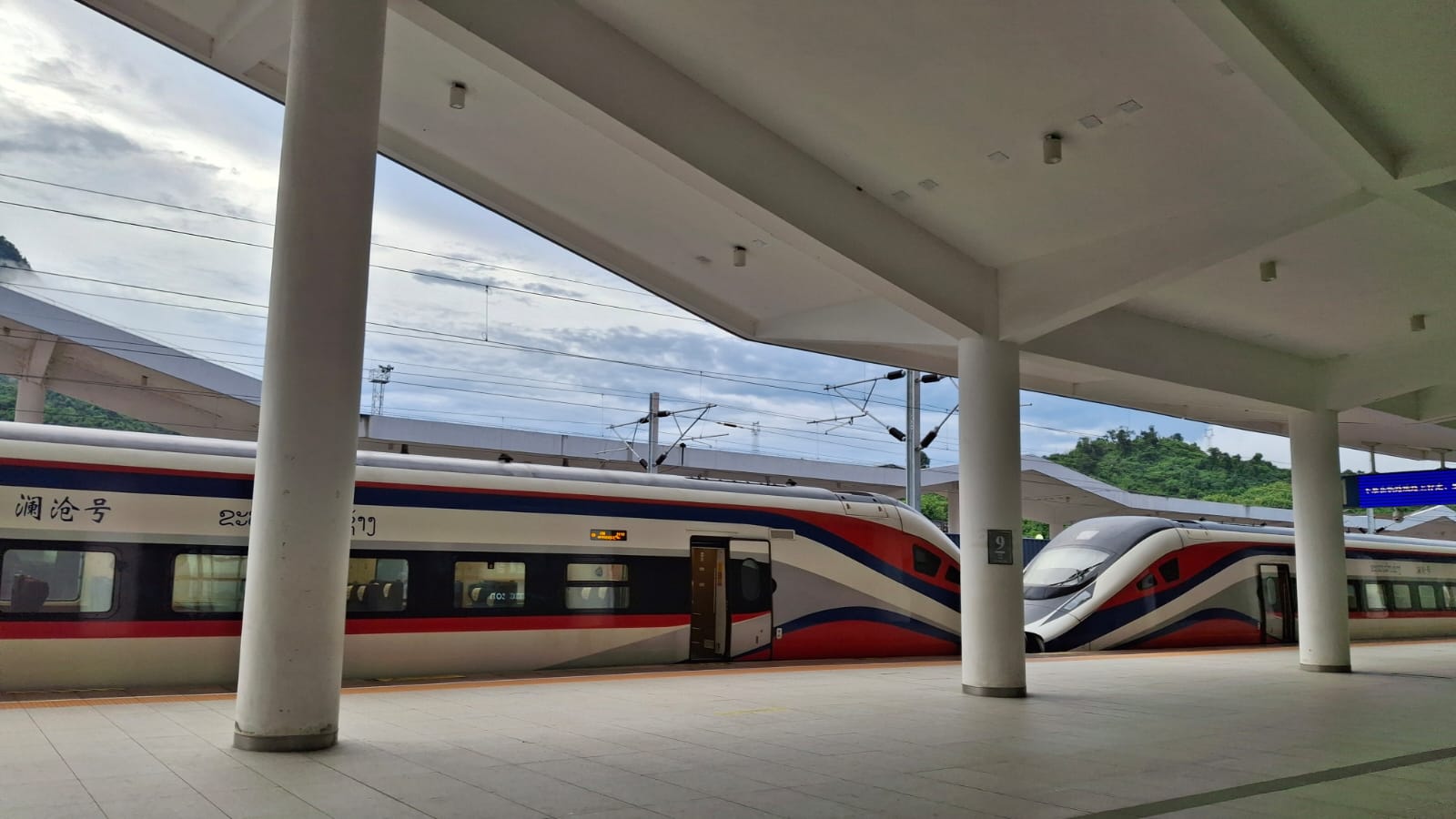
The fast trains, named Lane Xang (“a million elephants”), run at up to 160 km/h. Nine air-conditioned carriages, a first-class car with around fifty seats, six perfectly comfortable second-class coaches, a dining car, and a power socket at every seat. Announcements are in Lao, Chinese and English. In high season the trains are doubled up to cope with demand.
There is also a slower “K” service — cheaper, about an hour longer, but with far more generous luggage racks, which matters if you are travelling with large suitcases.
Timetables and journey times
Expect four to five departures a day in each direction between Vientiane and Luang Prabang, spread from early morning to late afternoon. Indicative journey times:
- Vientiane → Vang Vieng: around 1 hour
- Vang Vieng → Luang Prabang: around 1 hour
- Vientiane → Luang Prabang: around 2 hours
- Vientiane → Boten (Chinese border): 3.5 to 4 hours
One important warning: Laos-China Railway timetables change, sometimes with little notice, particularly between high and low season. No timetable found on a blog — including this one — should be treated as final. Always check a few days before you travel.
How much does a train ticket in Laos cost?
The train remains very affordable. As a rough guide, in second class:
- Vientiane – Luang Prabang: around US$17–25
- Vientiane – Vang Vieng: around US$9–14
- Vang Vieng – Luang Prabang: around US$9–14
- Vientiane – Boten: US$35–50 depending on class
First class costs roughly 50% more. On a two-hour ride, second class is genuinely enough — the seats are comfortable and legroom is fine. Spend the difference elsewhere.
Booking tickets: the tricky part
This is where the Lao railway catches international travellers out. You cannot book months ahead. Domestic tickets go on sale between three and seven days before departure, depending on the time of year — seven days at the time of writing — at 6:30 a.m. local time. The most popular trains sell out within minutes in high season.
The LCR Ticket app
This is the official and most reliable route. The app (iOS and Android) shows real availability and the current timetable. It accepts international VISA and UnionPay cards, as well as Alipay and WeChat Pay — with one caveat: payments with foreign cards sometimes fail without explanation. Have a backup plan.
Once booked, the app generates a QR code; for domestic journeys you simply scan it at the gate. Take a screenshot if you are travelling without a local data plan.
Ticket counters
Every station has counters, and there are also downtown ticket offices in Vientiane and Luang Prabang, usually open 8 a.m.–12 p.m. and 1 p.m.–5:30 p.m. A service fee of around 20,000 kip per ticket applies. Bring the passport of every passenger (or a photo): names and passport numbers are printed on the ticket. Keep that paper ticket until you leave the arrival station — it is scanned a second time on the way out.
Online resellers
International platforms let you “book” earlier, but they cannot buy your actual ticket before sales officially open. If the train is full that morning, you get a refund — and no seat. Convenient, but not a guarantee.
On the day: what nobody tells you
The stations are a long way out
This is mistake number one. Laos-China Railway stations were built well away from the towns they serve. Allow 45 to 60 minutes from central Vientiane and 30 to 45 minutes from Luang Prabang old town, more at rush hour. A “two-hour train” quickly becomes half a day door to door. Still far quicker than the road, but it has to be built into the day’s plan.
Arrive 30 minutes before departure if you already have your QR code, two hours before if you still need to buy or print a ticket. Waiting halls only open shortly before departure and there is very little shade outside, so turning up three hours early achieves nothing.
Airport-style security
LCR screening is strict, and it confiscates very ordinary items:
- pocket knives, Swiss Army knives included;
- all aerosols: spray sunscreen, spray deodorant, shaving foam;
- flammable materials.
Pack pump-action versions instead. If you are attached to a banned item, your hotel can usually forward it to your next stop — just ask, it is common practice.
Crossing into China
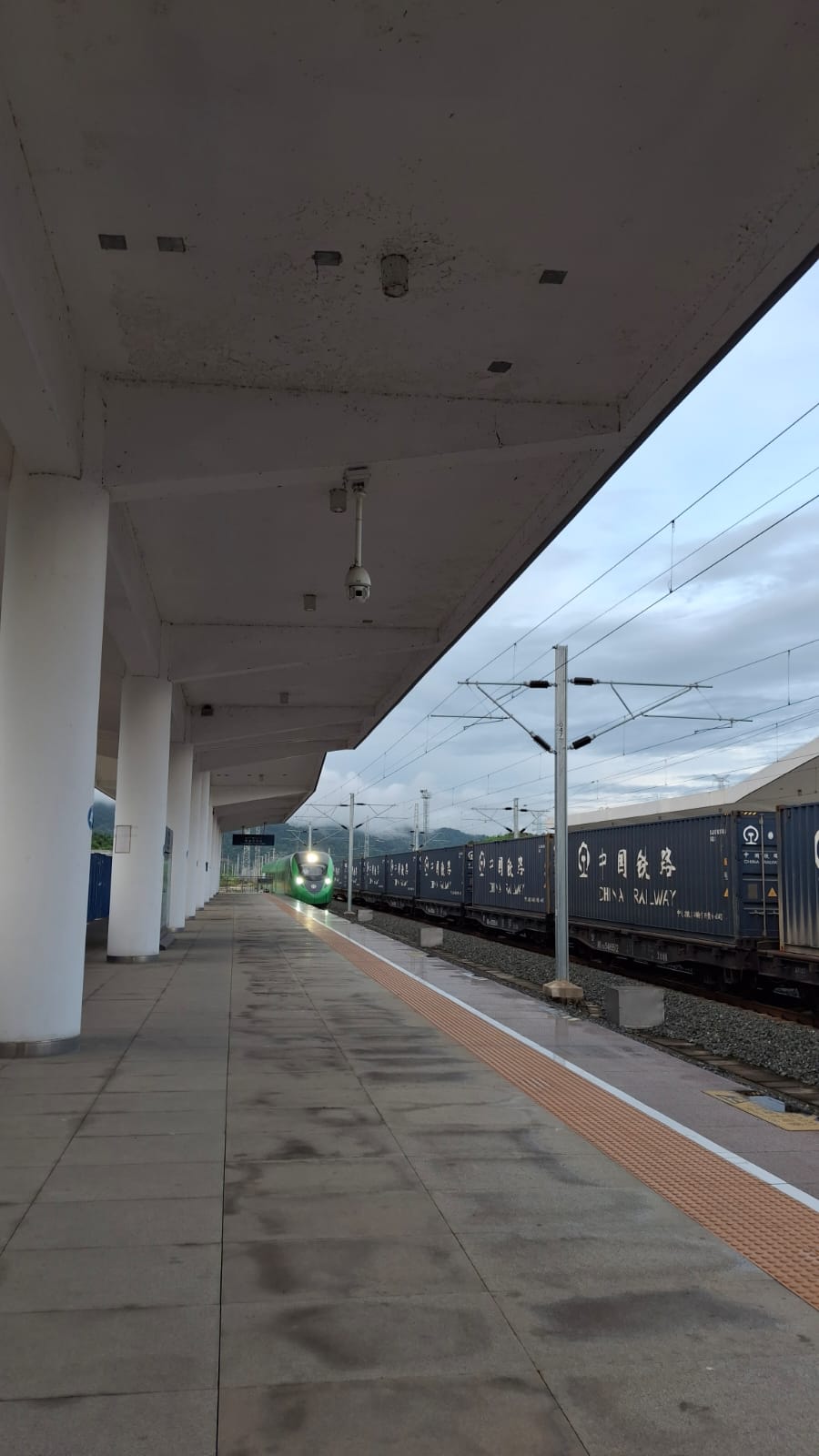
International tickets to Kunming can be bought up to fourteen days ahead, but only for journeys starting in Laos: a Kunming – Luang Prabang ticket cannot be booked through the Lao app. And the train exempts you from nothing — a Chinese visa and border formalities still need arranging well in advance.
Should you take the train at all?
Not always — and that is advice we often give against the grain. The train is outstanding on Vientiane – Vang Vieng – Luang Prabang: it frees up a whole day, which over a two-week trip genuinely changes what you can fit in.
But it does not serve the south (Pakse, the Bolaven Plateau, the 4000 Islands), nor Nong Khiaw, nor the Plain of Jars. And it does make something disappear: the road from Vientiane to Luang Prabang, with its villages, mountain passes and roadside markets, is still one of the finest drives in the country. Some of our travellers take the train one way and the road back. That is often the right answer.
Our itineraries that use the train
We always fit the rail timetable around the rhythm of the trip, not the other way round — with a private transfer to the station, tickets bought the moment sales open, and someone to see you onto the platform if needed.
- Charm and Authenticity of Northern Laos — the classic Vientiane, Vang Vieng, Luang Prabang route, where the train really earns its place.
- Nature and Culture in Laos — combining north and south, by rail and by road.
- City Break in Luang Prabang — the short escape, where saving a day counts double.
One last thought
The train has made Laos far more accessible, but it has also made the logistics tighter: a booking window of just three to seven days, out-of-town stations, shifting timetables. That is exactly the kind of detail a local agency handles so you never have to think about it.
Planning a trip to Laos? Tell us your dates and what you have in mind, and we will build your tailor-made itinerary — trains included — from our office in Vientiane. Request your free quote →