
It is the first landmark every traveller looks for on arrival in Luang Prabang: a green hill rising at the very heart of the peninsula, crowned by a small golden stupa that catches the light from dawn to dusk. Mount Phousi — “the sacred mountain” — separates the Mekong from the Nam Khane and watches over the UNESCO-listed town. Climbing its 328 steps is the rite of passage of any journey to Laos. But Phousi is much more than a viewpoint: it is a concentrate of history, legends and living faith. Follow the guide.
328 steps to the sky
The classic ascent starts on the main street, directly opposite the entrance of the Royal Palace. The main stairway, built in 1936-37, counts exactly 328 steps in the shade of frangipani trees. Allow a leisurely fifteen minutes — and bring water: under the Lao sun, the hill has to be earned. Phousi is not just a staircase either: it is a place of shaded walks, and the starting point of the picturesque corniche road that overhangs the Nam Khane from Vat Aphay to Vat Pak Khane.
Vat Pa Houak, the discreet guardian at the foot of the hill
Before climbing, push open the door of little Vat Pa Houak, “the monastery of the bamboo forest”, at the foot of the stairway. Built in 1861, it follows the Vientiane style: a gilded pediment on a blue background centred on the three-headed elephant, white octagonal pillars, and door frames of exceptionally rich floral carving. Inside, murals recount the miracle of Jamboupati, in which the Buddha appeared as “Buddha King of the World” to humble an arrogant prince — the origin of the “adorned Buddha” depicted with royal regalia instead of monastic robes. Since 1945 the sanctuary has housed a library of ancient manuscripts.
That Chomsi, the golden beacon of Luang Prabang
At the summit, That Chomsi dominates the whole plain. Erected in 1804 by King Anourouth and restored in 1914, it has one unique feature: its base is rectangular rather than square like every other that in Laos — an adaptation to the shape of the summit. Right beside it, the small cross-shaped sanctuary of Vat Chom Si, enlarged in 1796, was restored between the two world wars by the French School of Asian Studies. The summit buildings were entirely renovated in 1962: their archaeological interest is modest — but nobody climbs Phousi for archaeology…
The most beautiful view in Laos?
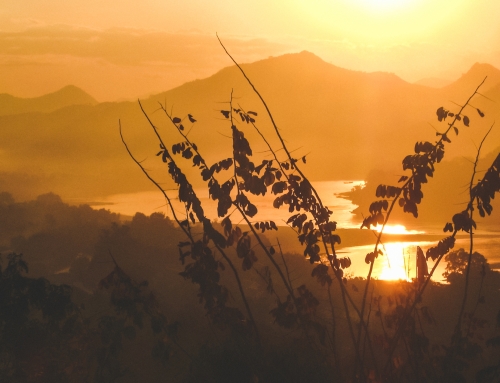
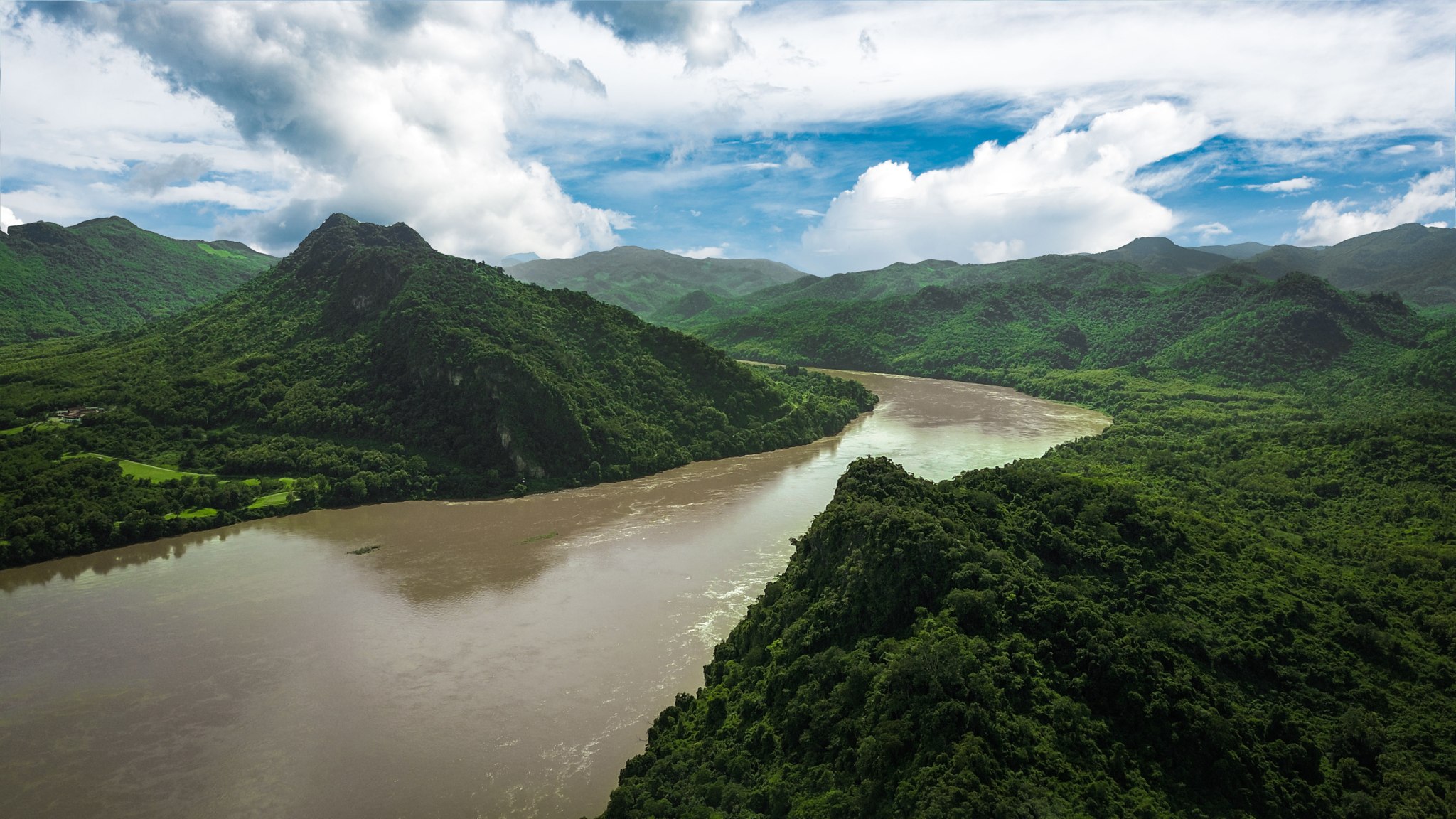
… You climb for the view, and what a view: from the top, Luang Prabang appears literally buried in greenery, an almost aerial vision of the peninsula. To the north-west, the Royal Palace traces its cross topped by a Khmer-inspired bell tower; all around, the Mekong and the Nam Khane wrap the town in their earth-coloured waters, and blue mountains close the horizon. At sunset the show is legendary — and crowded: to savour the panorama in peace, our guides prefer late morning, or daybreak just after the monks’ alms round. Our guide to the seasons in Laos will help you choose your light.
Pimai: when the deity of the year descends from Phousi
Phousi is also the stage of one of the most beautiful moments of Lao New Year: on the evening of the last day of Pimai, the procession of Nang Sang Khan, guardian deity of the new year, sets off from Vat Chom Si. Escorted by the Naga, the town’s sacred protector, and hundreds of lanterns, the young girl who embodies the deity descends from the summit like the head of a long ribbon of fire, down to the gardens of the Royal Palace. The evening traditionally ended with scenes from the Ramayana danced in the purest Lao tradition — and legend has it that the girl who plays Nang Sita will be married within the year…
Vat Tham Phousi, the cave monastery
On the southern flank of the hill, on the Nam Khane side, a path from Vat Chom Si leads to Vat Tham Phousi, “the monastery of the Phousi cave”. The sanctuary is built beneath a huge sandstone slab tilted at 45°, forming a natural cave. Most unusually for Lao iconography, the main image here is not the Buddha but a Phra Ka Chay — a pot-bellied buddha of gilded stuccoed brick, the work of the Venerable Houmphèng (1962). From there, a stairway lined with a Naga-shaped balustrade, rebuilt in 1965 by the town’s high-school students, leads back down to the street along the Nam Khane: our favourite way down, away from the crowds.
Our tips for the visit
- Climb early (before 9 am) or in the late afternoon outside the dry season: the light is beautiful and the heat bearable.
- Make it a loop: up the stairway facing the Royal Palace, down the Naga staircase on the Nam Khane side, then back along the corniche road.
- Combine the climb with the Royal Palace Museum and the Phra Bang just opposite, then Vat Xieng Thong at the tip of the peninsula.
Would you like to climb Phousi at daybreak with a guide who tells you all about Nang Sang Khan and the adorned Buddha? Write to us — a local agency in Laos since 2002, we create your tailor-made journey.