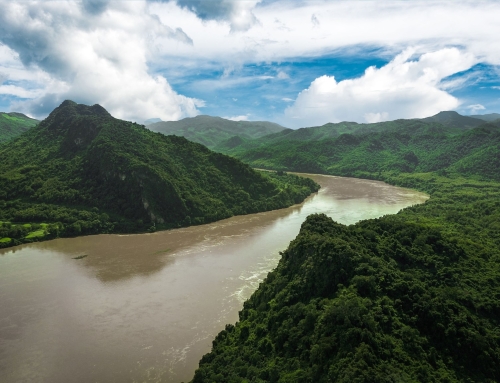

Facing Luang Prabang, across the Mekong, lies a world most visitors only glimpse from a café terrace: the right bank, the district of Chomphet. No traffic, no shops — just villages, footpaths, a teak forest, and a handful of ancient monasteries that keep the memory of the “Phrabang Road“. Ten minutes by boat from the UNESCO city, this is Luang Prabang as it used to be: silent and quietly overwhelming. Follow the guide.
Crossing the river: ten minutes, another century
The crossing is made by pirogue or ferry from the landing behind the former Royal Palace. Within minutes the bustle dies away: you step ashore among villages that still live to the rhythm of the river, the paddies and the orchards. Four monasteries alone are worth the half-day: Vat Tham, Vat Long Khoun, Vat Chom Phet and Vat Xieng Mene.
Vat Tham, the monastery of the caves
Directly opposite Vat Xieng Thong, the “monastery of the caves” occupies a large limestone cave in the hillside: a stone staircase, a small three-tiered Burmese-style bell tower, altars sunk in half-light. The cave has always served as a sanctuary for old Buddha images from vanished monasteries: dozens of weathered wooden statues slumber here, stacked in the darkness. Legend even has it that a secret passage runs under the river to the Royal Palace…
Vat Long Khoun, the retreat of kings
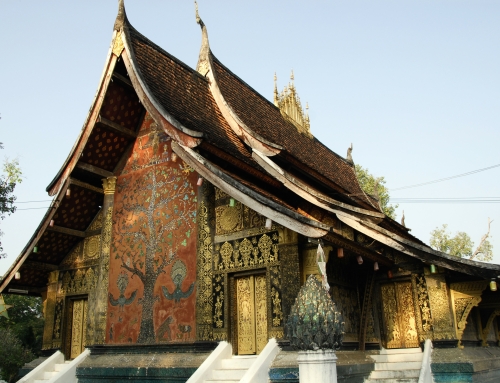
The “monastery of the blessed chant” is the most endearing on this bank. Its sim has two ages: the rear dates from the 18th century, while the portico — with its lovely carved wooden pediment — was rebuilt in 1937. On the façade, two great painted Chinese warriors stand guard on either side of the door; inside, murals recount the previous lives of the Buddha.
This peaceful place held a key role in royal ritual: before his coronation, the sovereign came here for a three-day retreat, before entering the city in majesty through the landing stage of Vat Xieng Thong. Around the sim, note the koutti, the monks’ quarters from the last century: wood above, stone below for foundations and stairs.
Vat Chom Phet, the belvedere of serenity
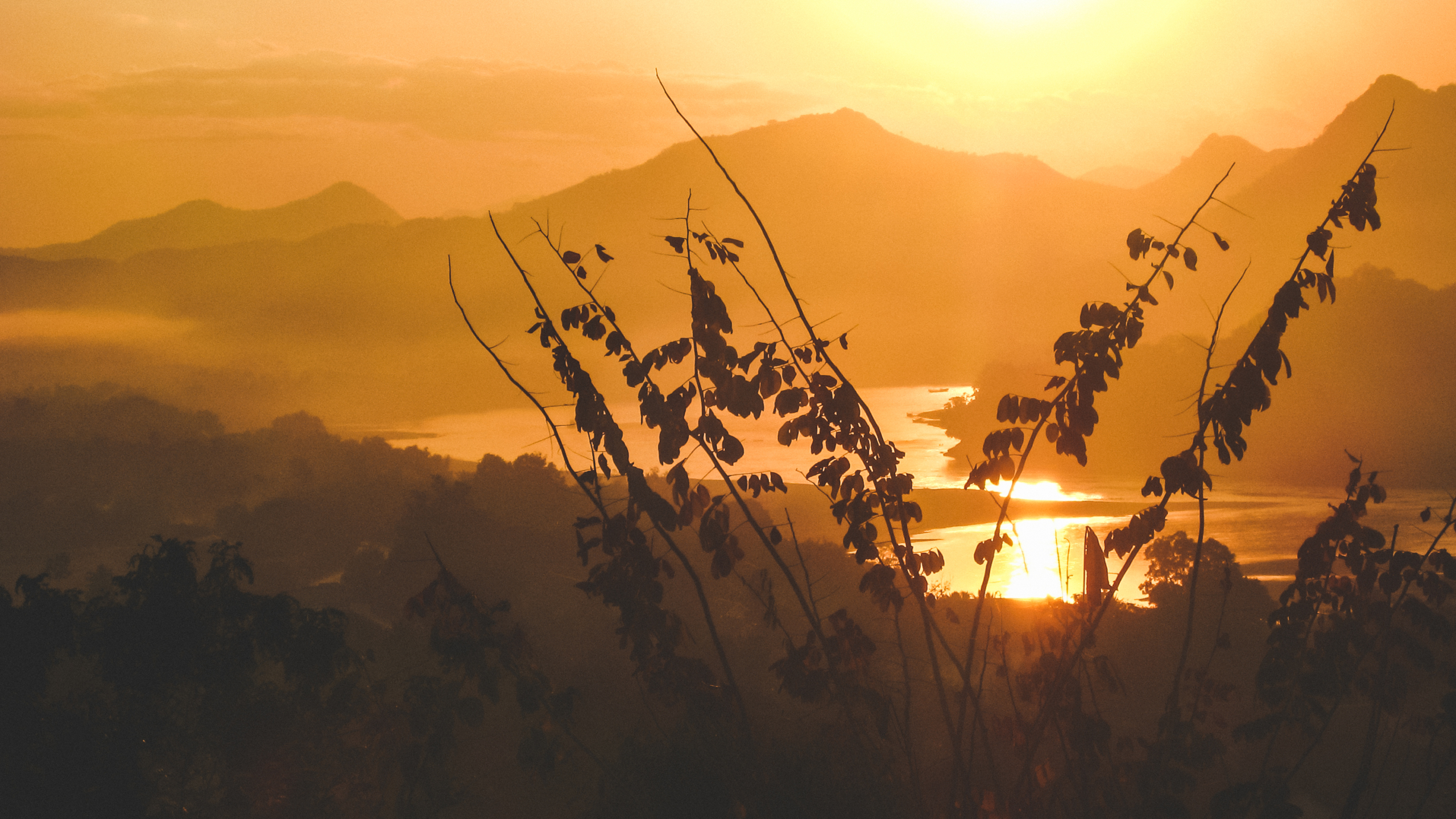
On top of a small isolated hill overlooking the Mekong, the “monastery of the diamond point” matters less for its sim — classical in style, rebuilt in the early 20th century — than for its setting: from up here the view sweeps over the river, the peninsula and the golden roofs of the city. The atmosphere of quiet serenity is exactly what one crosses the river to find.
Vat Xieng Mene and the Phrabang Road
Buried in greenery, the “monastery of the paradise city” is of very ancient foundation — perhaps the 14th century. The present sim, with its composite roof, dates from the late 19th century; admire the delicate decoration of the octagonal pillars of the portico. If the village of Ban Xieng Mene once prospered, it is because it commanded the caravan trail to Siam and Burma: the famous “Phrabang Road”, along which the Phra Bang, the city’s sacred Buddha, came home from Bangkok in the mid-19th century.
Upstream from the landing, on the hillside, the ruins of Vat Chom Cheng (18th century) add a romantic note to the walk.
The royal cemetery in the teak forest
Two kilometres from Ban Xieng Mene, a little off the Phrabang Road, a clearing among the teaks shelters Pa Xa Louang, the royal cemetery. Here rest the members of the royal family who could not be cremated under religious interdicts: women who died in childbirth, infants, victims of epidemics. Among them stands the mausoleum of Queen Kham Ouane (1885-1905). A moving, timeless place, reached by a beautiful forest path.
Practical tips
- Allow half a day: the crossing, the four monasteries on foot along the riverbank path, and the detour to the royal cemetery for walkers.
- Early morning or late afternoon: superb light on the river, gentler heat — and the return crossing at sunset, facing the city, is unforgettable.
- Closed shoes and water: the trails are easy but dusty in the dry season, slippery after rain.
- Small change: for the boat and donations at the vats.
The right bank slips perfectly into a Luang Prabang stay — between the temples of the peninsula and the Kuang Si waterfalls. Talk it through with our team: a local agency in Laos since 2002, we weave these secret discoveries into your tailor-made journey in Laos.