
Boun Pi Mai — literally “New Year festival” — is the most important celebration in the Lao calendar. Every year, in mid-April, Laos comes to a standstill for three days to welcome the Lunar New Year in an atmosphere of joy, Buddhist rituals and epic water fights. If there is only one festival to experience in Laos, it is this one.
Boun Pi Mai: when and why?
Pi Mai Lao takes place every year between April 14 and 16 according to the solar calendar, although the festivities often extend over a full week. These dates correspond to the sun entering the sign of Aries in the Theravada astrological calendar — a time of cosmic renewal.
Pi Mai marks the start of the agricultural cycle, the end of the dry season and the imminent arrival of the first monsoon rains. It is a New Year celebrated with family, in the community and with the monks — a time of purification, gratitude and shared happiness.
The great traditions of Boun Pi Mai
Pi Mai tak bat
As every morning, the monks go out at dawn to receive offerings from the faithful. But during Pi Mai, the tak bat ceremony takes on a special dimension: families bring special offerings (fragrant sticky rice, flowers, incense) and the monks bless participants with sacred water for the New Year. In Luang Prabang, this procession through the lanes of the old town is breathtakingly beautiful.
New Year baci
The baci (or synkhouan) is a Lao blessing ceremony that marks important moments in life: births, weddings, departures and returns. During Pi Mai, baci ceremonies are held in families and temples to welcome the New Year under favourable auspices. White cotton strings are tied around the wrists to keep the souls in place and attract good luck.
The Phra Bang procession
In Luang Prabang, the most sacred Pi Mai ceremony is the procession of the Phra Bang — the city’s and Laos’s protective golden Buddha, usually kept at the Royal Palace Museum. During Pi Mai, the statue is carried in procession to Vat May, where devotees ritually wash it with scented water, thereby transferring its merits to the community for the New Year.
Water fights
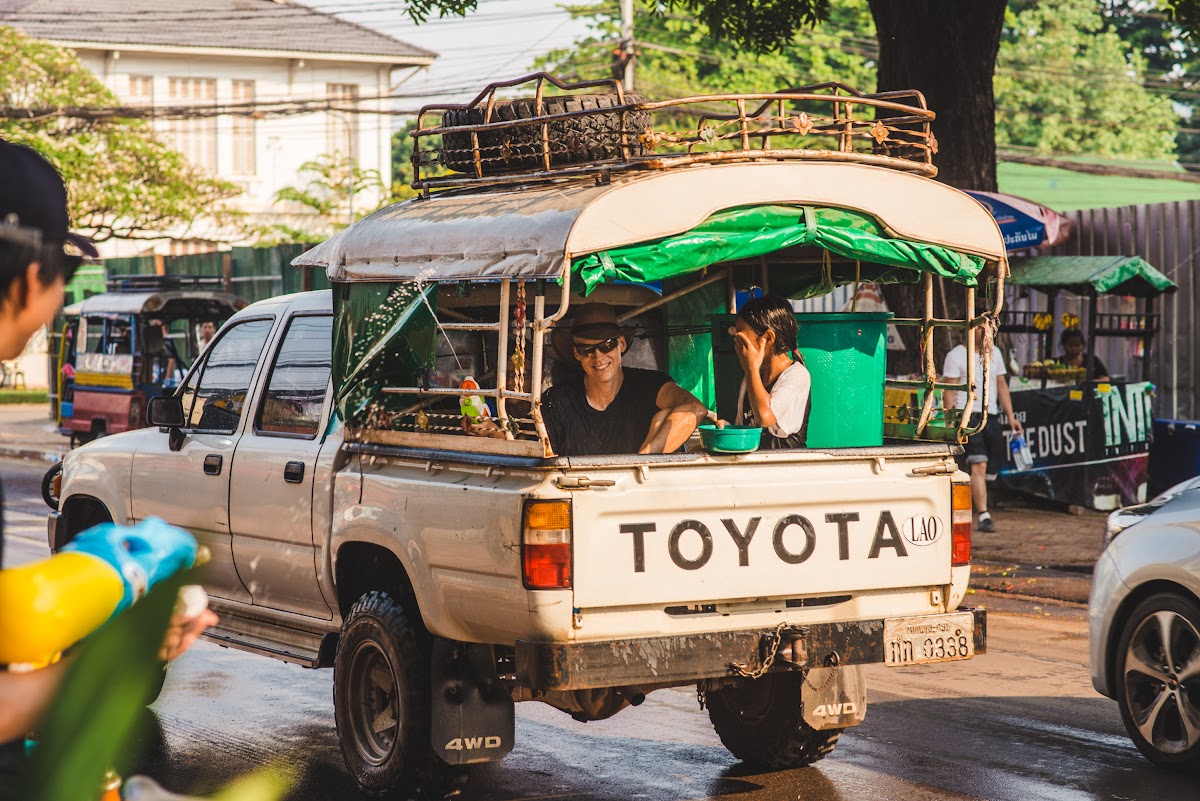
This is the most festive — and most unexpected — aspect of Pi Mai. For three days, everyone splashes everyone. Buckets, water guns, garden hoses, water trucks: nothing and no one is spared. Water symbolises purification, renewal and good luck for the year ahead. Getting soaked is a blessing, not an insult.
Practical tip: protect your phone and cameras in waterproof bags. Dress lightly. And join in enthusiastically — refusing to be splashed would be a real shame!
Where to celebrate Pi Mai in Laos?
Luang Prabang: the most beautiful celebration
Without hesitation, Luang Prabang is the best place in Laos to experience Pi Mai. A former royal capital and UNESCO city, it is the spiritual heart of the country — and its Pi Mai celebrations combine intact Buddhist traditions with a lively, popular festival atmosphere. The Phra Bang procession, ceremonies in the temples (Vat Xieng Thong, Vat May), water fights in the colonial lanes: it is a total immersion in Lao culture. Book your accommodation well in advance — hotels sell out months before the event.
Vientiane: a relaxed, popular celebration
The capital celebrates Pi Mai with less religious pomp than Luang Prabang, but with just as much popular enthusiasm. The water fights on Fa Ngum Road (along the Mekong) and around Pha That Luang are unforgettable. Pi Mai night markets offer food stalls, live music and traditional performances. If you are in Vientiane at this time, you will not be disappointed.
Villages: authenticity without the tourists
For a more intimate experience, some travellers choose to experience Pi Mai in a remote village in Northern Laos. Ceremonies are more intimate, families more welcoming, and the spiritual dimension more present. Asia Safari can organise this type of cultural immersion in villages in the Luang Namtha or Nong Khiaw region.
Practical tips for Pi Mai in Laos
Book well in advance. Pi Mai is the absolute peak season for tourism in Laos. Hotels in Luang Prabang sell out 6 months in advance. Vientiane–Luang Prabang flights are fully booked. Asia Safari recommends confirming your Pi Mai stay as early as November–December for peace of mind.
Allow at least two to three days. The festivities stretch over a week (before and after April 14–16). Arriving the day before and leaving afterwards lets you experience both sides: morning religious ceremonies and afternoon popular celebrations.
Respect sacred places. In temples and during Buddhist ceremonies, behave discreetly: switch off phones, dress modestly (shoulders and knees covered), and do not take photos unless invited to do so.
Protect your belongings. For water fights in the streets, anything that cannot get wet should stay at the hotel or in a waterproof bag.
Asia Safari includes Pi Mai in its tailor-made Laos tours, with secure accommodation in Luang Prabang and local support so you do not miss any of the ceremonies. Contact us now to plan your Pi Mai trip.
To go further
To prepare your trip around Pi Mai, see our guides: What to do in Luang Prabang, the temples of Luang Prabang, understanding Lao Buddhism and our complete guide to choosing the best time to visit Laos.