
In Laos, the temple — or Vat — is not just a place of worship. It is the heart of village life, the school, the court, the refuge, the place of celebration. To understand Laotian Buddhism is to understand the very soul of the Lao people. Here is a guide to deciphering what you will see, hear, and feel in the temples of Laos.
Theravada Buddhism: The Way of the Elders
Laos practices Theravada Buddhism — literally “the way of the Elders” (thera means “elder” in Pali). It is the same branch as that found in Myanmar, Cambodia, Thailand, and Sri Lanka. It differs from Mahayana Buddhism (practiced in China, Vietnam, and Japan) by its adherence to the original teachings of the historical Buddha, Siddhartha Gautama.
In Theravada, the Buddha is not a god but a man — a sage who attained Enlightenment (Nirvana) and whose path can be followed by any human being. The statues in temples therefore represent not a deity to be prayed to, but a model to imitate. The gods of Indian mythology — Indra, Brahma — exist in this pantheon, but as beings superior to ordinary humans, not yet having reached Nirvana, and thus inferior to the Buddha.
Theravada Buddhism is based on the accumulation of merits (boun in Lao): every good deed — donation to monks, offering to the temple, act of compassion — brings the individual closer to Enlightenment in successive lives. It is this principle of merit that explains the generosity visible everywhere in Laos.
Monks: A Special Place in Society
In Laos, entering the monastic order, even temporarily, is a normal step in a man’s life. Many young Laotian men spend a few weeks or months as novices or monks, accumulating merits for themselves and their families. The monastery has long been the only school accessible to rural children.
Monks (phrabat) live according to 227 rules of conduct. They do not cook, do not touch money, and cannot eat after noon. They live entirely from the generosity of the faithful. But unlike Catholic priests, they are not “officiants” — they do not celebrate sacraments. Their role is to practice and teach the way of the Buddha.
Every morning before sunrise, in all towns and villages of Laos, monks go out in procession for the tak bat — the collection of food. The faithful, kneeling along the street, place sticky rice and offerings into the monks’ bowls. This daily ritual, unchanged for centuries, is the most visible expression of the bond between the community and its monks. In Luang Prabang, the sunrise tak bat is one of the most moving spectacles there is.
What is a Vat? Anatomy of a Lao Temple
The word Vat (or Wat) refers to the entire monastic complex — not just the main building. A complete Vat includes several elements:
The sim or vihan — the main sanctuary, where Buddha statues are kept and religious ceremonies take place. It is the most richly decorated building, with its cascading roofs and facades adorned with nagas (mythical guardian serpents).
The that or stupa — the bell- or lotus-shaped funerary towers, which house relics or the ashes of important figures. Each stupa is a monument of merits accumulated by its donors.
The ho tay — the library that preserves sacred texts (tipitaka) written on palm leaves or mulberry paper manuscripts. It is often built on stilts above a pool of water to protect the texts from termites.
The koutti — the monks’ living quarters, simple and functional buildings arranged around the complex.
The sala — the open meeting hall, where the village community gathers for secular and religious ceremonies.
The baci or synkhouan — the altar for blessing ceremonies, a pyramid of white flowers used during important life events (births, weddings, departures on journeys).
Reading a Buddha Statue: The Mudras
In Laotian temples, Buddha statues adopt different postures (mudra), each with a precise meaning. The main ones you will encounter:
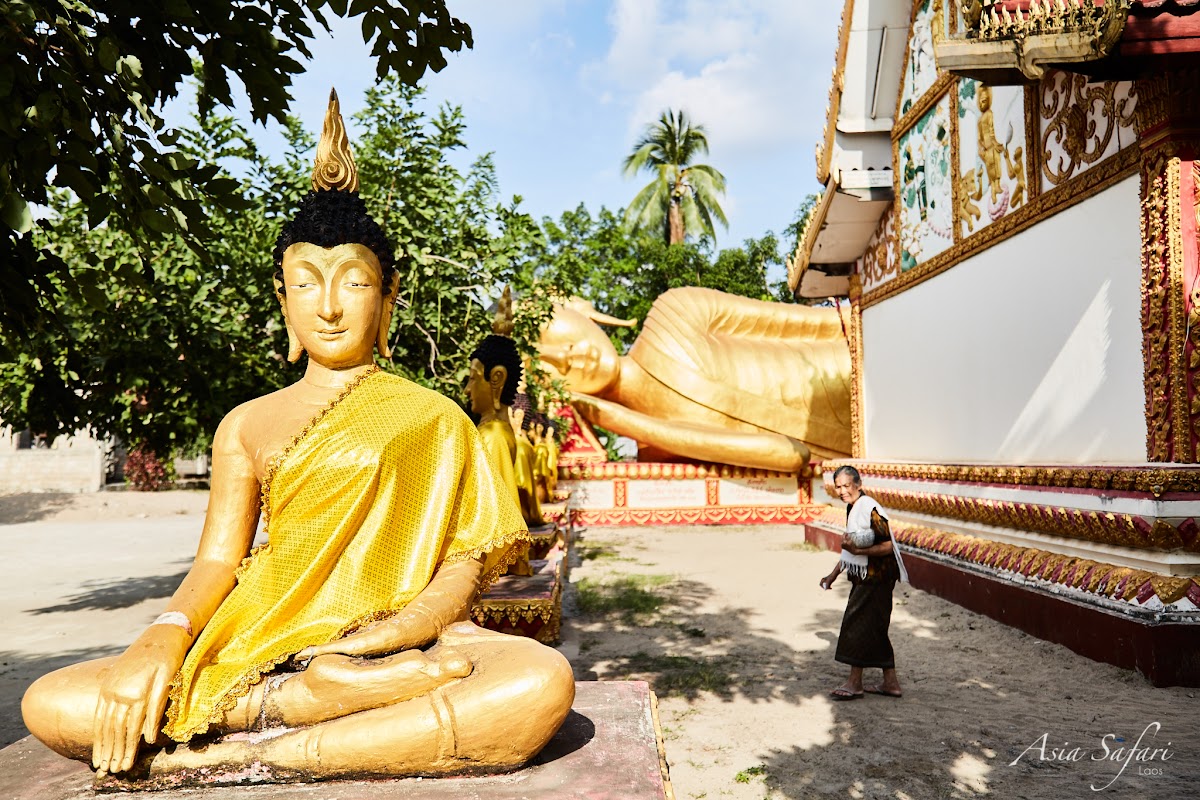
Maravijaya — Seated Buddha, right hand touching the earth. This is the posture of Enlightenment, the most common in Laos.
Ham Nhat — Standing Buddha, both hands raised palms outwards. Means “Calling for Rain” or “Calming the Waters.” Very characteristic of the Lao style — this is the posture of the famous Phra Bang of Luang Prabang.
Samathi — Meditating Buddha, hands placed on the lap. Posture of concentration.
Nirvana — Buddha lying on his right side, representing the passage to Nirvana. Found in sacred caves and some ancient temples.
Major Buddhist Festivals in Laos
The Lao calendar is punctuated by Buddhist festivals. The most important for travelers:
Pi Mai Lao (Lao New Year, mid-April) — three days of festivities, processions, ritual water splashing, the Phra Bang ceremony in Luang Prabang. The most festive event of the year.
Boun Bang Fai (Rocket Festival, May) — artisanal fireworks launched skyward to call for rain and fertility. Spectacular and popular in all provinces.
Boun Ok Phansa (end of the rainy season retreat, October-November) — end of the three months during which monks do not leave their monastery. Celebrated by the boat festival in Vientiane and Luang Prabang, with longboat races on the Mekong.
Boun That Luang (November, Vientiane) — the most important national religious festival in Laos, gathering around the golden stupa of That Luang, the emblem of the country.
How to Behave in a Lao Temple
A few simple rules will allow you to visit Laotian temples respectfully: cover your shoulders and knees (a sarong is often available at the entrance), remove your shoes before entering the sanctuary, never point a finger or foot at a Buddha statue, ask for permission before photographing monks, and avoid approaching monks if you are a woman — in the Theravada tradition, physical contact with a woman is forbidden to religious men.
Asia Safari systematically includes an in-depth cultural visit in its stays in Laos. Our local local guides explain the meaning of each ritual, each symbol. Understanding Buddhist culture means understanding Laos — and leaving with much more than just photos.
Do you want to discover Laotian Buddhism from the inside? Contact Asia Safari for a tailor-made cultural trip in Laos.
To go further
Deepen your knowledge of Laotian Buddhist culture: History of Luang Prabang · Guide to the Temples of Luang Prabang · The Pha Singkham Buddha of Muang La · Culture and Customs of Laos., Boun Pi Mai (Lao New Year)