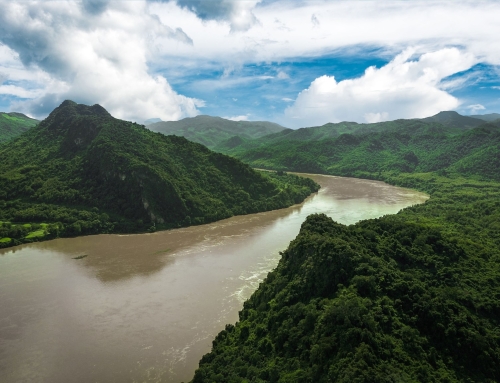

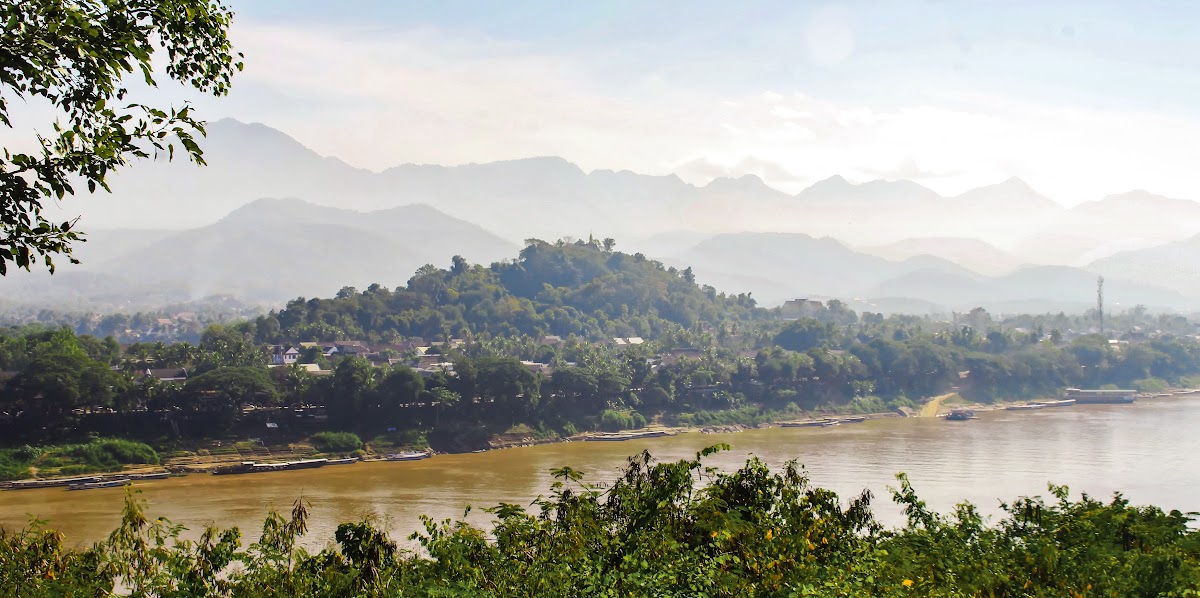
Nestled in a meander of the Mekong, at the confluence of the river and the Nam Khan, Luang Prabang is one of the best-preserved cities in Southeast Asia. Listed as a UNESCO World Heritage site in 1995, it exudes a unique way of life, set among golden temples, frangipani forests, and saffron-robed monks. But to understand this Laotian jewel, one must trace the thread of its history—over a thousand years of royalty, wars, renown, and rebirths.
Muong Sua, Xieng Dong, Xieng Thong… the names of a royal city
The city today bears a name it has not always held. Its origins date back to a settlement called Muong Sua, mentioned in Laotian chronicles long before the Christian era. It was only in the 14th century, with the founding of the powerful kingdom of Lane Xang—the “Kingdom of a Million Elephants”—that the city attained royal stature under the name Xieng Dong Xieng Thong.
In 1353, Prince Fa Ngum, educated at the Khmer court of Angkor, marched north with an army and a Cambodian wife, unified the scattered Laotian principalities, and founded the kingdom of Lane Xang. He established his capital at Xieng Dong Xieng Thong, granting it a primary political and religious role throughout the Indochinese peninsula.
It was only in 1491 that the city received its current name, when King La Nam Sene Thay had the Phra Bang—the kingdom’s gold palladium Buddha—transported from Vientiane and installed the statue at the Vat Xieng Kang temple. In tribute to this relic, the city changed its name to Muong Louang Phrabang, the “Great City of the Phra Bang.”
The Phra Bang: The Buddha that gave the city its name
The Phra Bang is a gilded bronze statue representing the Buddha standing in the Ham Nhat attitude—”Calming the family quarrel”—with both hands raised and palms facing outward. It measures 83 cm and weighs 43.4 kg. Its fine execution places it among the masterpieces of Southeast Asian Buddhist art.
Cast in Ceylon in the 8th or 9th century, the statue reached Cambodia around the 11th century. In 1358, the Khmer sovereign presented it to Prince Fa Ngum before he left Angkor to reconquer his kingdom. Fa Ngum initially left the Phra Bang in Vientiane; it was his successor La Nam Sene Thay who, in 1489, brought it to Luang Prabang. Since 1947, it has been kept in the Vat Ho Phrabang royal chapel, in the gardens of the Royal Palace.
The history of the Phra Bang is also a story of captures and restitutions. The Siamese seized it for the first time in 1779, returned it four years later, then took it again in 1827. It only returned permanently to Laos in 1839, handed over to King Soukhaseum of Luang Prabang.
From royal capital to colonial city
Luang Prabang was the capital of the Kingdom of Lane Xang from its foundation until 1560, when King Sayasetthathirath transferred the capital to Vientiane to better resist Burmese invasions. The city then experienced centuries of vicissitudes: the Lao New Year fire of 1774 which destroyed the entire lower town, looting by the Black Flags (Deo Van Tri’s “Ho”) in 1887, and successive wars and occupations.
On the eve of French colonization, Luang Prabang was no more than the capital of a small vassal kingdom. It was King Sisavang Vong, supported by his two vice-kings Boun Khong and Prince Phetsarath, who undertook the major reconstruction of the city and its restoration as a religious and royal capital. In 1947, Luang Prabang regained the rank of royal capital of unified Laos, a status it maintained until 1975.
The UNESCO listing in 1995: A rebirth
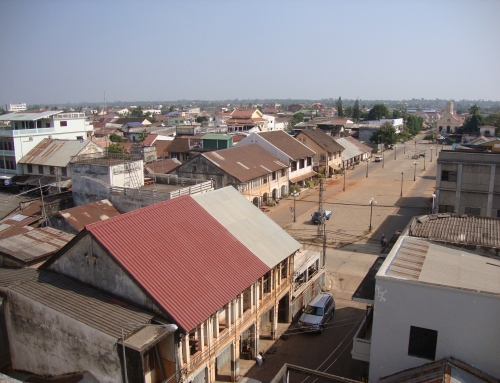
In 1995, UNESCO designated Luang Prabang a World Heritage City. The decision recognized the exceptional universal value of its historic center: a unique ensemble that harmoniously blends Laotian Buddhist religious architecture—some 30 active temples—and 19th-century French colonial houses, within a preserved natural setting between the Mekong and the Nam Khan.
This listing triggered a true renaissance. Old colonial residences were transformed into boutique hotels, pagodas were restored, and cultural tourism flourished. But unlike other heritage cities in Asia, Luang Prabang has managed to preserve its essence: its inhabitants still live there, its monks process every dawn, and its artisans weave and carve just as their ancestors did.
Luang Prabang today: Spirituality and way of life
What strikes the visitor is the serene coexistence of the sacred and the everyday. Every morning before sunrise, hundreds of saffron-robed monks emerge in silent procession for the tak bat—the collection of rice from the faithful kneeling along the streets. This daily ritual, unchanged for centuries, is the living pulse of the city.
The inhabitants of Luang Prabang are proud of their city and have kept their Laotian traditions intact, both religiously and artistically. Fine craftsmanship—silk weaving, wood carving, goldsmithing—is passed down from father to son, from master to apprentice, without the influx of tourism having diluted it.
To visit Luang Prabang is to understand the deepest parts of Laos: a refined Buddhist civilization, a peaceful relationship with time, and natural beauty—mountains, rivers, waterfalls—within easy reach.
Are you planning a trip to Luang Prabang? Asia Safari has been designing tailor-made stays for over 25 years. Our local English-speaking guides will help you discover the city far beyond the beaten track. Contact us.
To go further
Extend your discovery of Luang Prabang with our thematic guides: Must-see temples of Luang Prabang · Understanding Theravada Buddhism in Laos · What to do in Luang Prabang · Kuang Si Waterfalls.
To go further: discover the story of the Phra Bang, the golden Buddha that gave the city its name.