
Luang Prabang has about thirty active Buddhist temples, concentrated on a peninsula of a few square kilometers. It is probably the highest density of Wats in all of Southeast Asia. Each has its own character, history, and hidden treasure. Here are the must-sees — those that Asia Safari recommends to all its travelers, whether they have two days or two weeks.
Wat Xieng Thong — the jewel of Luang Prabang
Built in 1560 by King Setthathirath, Wat Xieng Thong (“Temple of the Golden City”) is the most beautiful and photographed in Luang Prabang. Located at the northern tip of the peninsula, on the banks of the Mekong, it is the most accomplished example of classical Lao religious architecture.
Its cascading roof, with tiers descending to the ground like a breaking wave, is characteristic of the Luang Prabang style. Inside the main sanctuary, the sim, the golden columns, walls covered in gilding, and lined-up Buddhas create an atmosphere of rare intensity. The Red Chapel (ho tai) houses an extraordinary glass mosaic representing the tree of life. Do not miss the royal funeral carriage displayed under a shed — a work of art in itself.
Practical: open daily, entrance fee. Proper attire required — shoulders and knees covered.
Wat Wisunarat — the oldest inhabited temple
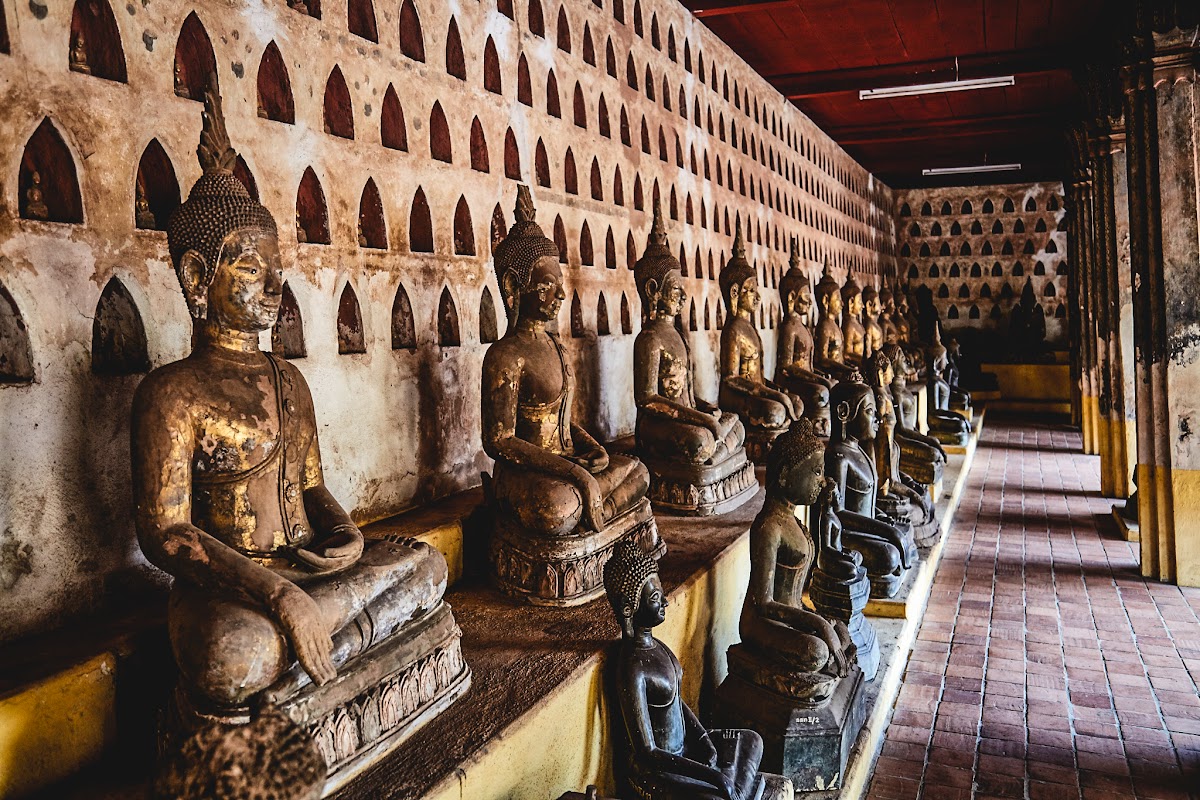
Founded in 1513 by King Wisunarat, Wat Wisunarat is the oldest temple still in activity in Luang Prabang. It was here that the Phra Bang, the kingdom’s palladium Buddha, was kept for nearly half a century. The vihan (sanctuary) now houses an impressive collection of standing and seated Buddhas, some dating back to the 15th century, and ancient bronze drums.
Opposite the sanctuary stands That Makmo — the “Watermelon Stupa” — a stocky and massive hemispherical stupa, unusually rounded for Laos, which is more reminiscent of the stupas of Burma. It also dates from the 16th century and remained intact during the pillaging by the Black Flag Army in 1887.
Wat Mai — the temple of the Royal Palace
Built in the 18th century, Wat Mai Souvannapoumaram was for a long time the residence of the head of Buddhist monks in Laos. It was here that the Phra Bang was housed from 1894 until independence in 1947. Its golden facade, covered in stucco bas-reliefs representing scenes from the Ramayana and the life of Buddha, is one of the most richly decorated in the city.
Wat Mai is adjacent to the Royal Palace (now the National Museum) and Wat Ho Phrabang, the modern chapel built to house the Phra Bang. Together they form the ceremonial heart of Luang Prabang, where the major rituals of the Lao New Year (Pi Mai) take place in April.
Wat Pak Khane — discretion on the banks of the Mekong
Less frequented than its neighbors, Wat Pak Khane (“Temple at the mouth of the Khane River”) is worth the detour for its sober and authentic architecture. It is one of the few temples in Luang Prabang whose sim does not have a portico — a rare architectural feature. Its location on the banks of the Mekong, at the tip of the peninsula, makes it an ideal place for contemplation at sunset.
Wat Tham Phousi — the temple of the sacred cave
Carved into the hillside at the foot of Mount Phousi, Wat Tham Phousi houses a natural cave transformed into a sanctuary. Inside, a statue of the reclining Buddha is bathed in soft light, surrounded by offerings and incense sticks. The atmosphere is particularly peaceful, far from the hustle and bustle of the city center.
Mount Phousi itself, which is climbed via a 328-step staircase, is crowned by Wat Chomsi and its golden stupa visible from all over the city. It is THE spot to watch the sunset over the Mekong — arrive early to find a place.
Wat Pa Houak — forgotten frescoes
Tucked away in a quiet alley in the center, Wat Pa Houak is one of the lesser-known treasures of Luang Prabang. Its interior houses mural frescoes of great finesse representing scenes of 19th-century Lao life — Portuguese merchants, period costumes, court scenes. An exceptional historical and artistic document, often overlooked by classic tourist circuits.
Wat Sene — the temple of a hundred thousand treasures
Built in 1718 with donations from a thousand Lao families (hence its name: sene means one hundred thousand in Lao), Wat Sene Soukharam is characteristic of the Luang Prabang architectural style with its yellow and red facade and overlapping roofs. It is one of the most vibrant temples in the city, frequented daily by local residents.
The Tak Bat Ceremony: Monks at Dawn
Every morning at dawn (5:30–6:00 AM), hundreds of saffron-robed monks walk through the streets of Luang Prabang in a silent procession to receive offerings of sticky rice from the faithful. This is the tak bat, one of the most moving and photographed experiences in all of Southeast Asia. Please observe the rules: dress modestly, remain silent, and do not disturb the ceremony with flashes or by approaching the monks too closely.
Practical tips for visiting the temples of Luang Prabang
Most temples are open from 8:00 AM to 5:00 PM, with a possible break in the middle of the day. Entrance is generally paid (10,000 to 20,000 kip). A few essential rules: shoulders and knees covered (a sarong can be borrowed at the entrance), shoes removed before entering the sanctuary, silence and discretion in the presence of monks.
For a deeper experience, Asia Safari offers temple tours accompanied by a local English-speaking guide who will explain the Buddhist iconography, the ongoing rituals, and the history of each site. Some visits may include a conversation with the monks, who often practice their languages with visitors.
Want to discover the temples of Luang Prabang with a local guide? Contact Asia Safari for a tailor-made stay in Laos.
To go further
To better prepare for your visit to the temples of Luang Prabang: The history of Luang Prabang · Understanding Theravada Buddhism in Laos · What to do in Luang Prabang · 15-day Laos tour.