
After the visa, this is the question we answer most often before departure: how do you actually pay for things in Laos? The honest answer has changed a lot in a few years. QR payments have swept the country faster than anyone expected, ATMs have multiplied in the towns — and there are still whole valleys where a folded banknote is the only thing that works.
Here is what we tell our travellers from our office in Vientiane, as of September 2026.
The kip is the currency that matters
The national currency is the Lao kip (LAK). As a reference, on 11 September 2026 BCEL’s banknote buying rates were roughly 22,150 kip per US dollar and 25,700 kip per euro. Rates change: check BCEL’s daily rates before exchanging cash. The rate applied to a card transaction may differ.
One practical consequence: you will be handling very large numbers. It is easy to misplace a zero in the first few days. At the indicative rate above, 100,000 kip is about 4.50 USD. Check the number of zeros before paying.
The banknotes
Notes in daily use run from 1,000 up to 100,000 kip, the largest denomination in circulation. Coins have effectively disappeared from everyday life. Two habits worth building:
- Keep small notes. A tuk-tuk driver or a morning-market vendor may not have change for a 100,000 note.
- Break big notes where change exists — minimarts, restaurants, hotels — not on the street.
Dollars and Thai baht: what is still true
You will read that “US dollars are accepted everywhere in Laos”. Today dollars and Thai baht are still taken in some hotels, agencies and shops in the larger towns, but at an in-house rate that rarely favours you, and more and more businesses price in kip only.
Our advice: pay in kip. Carry 100 to 200 US dollars in clean, new notes as a safety net — to exchange at a bank or licensed provider. Euros also work in the main towns; there is no need to buy dollars solely to exchange them again for kip.
ATMs: limits, fees, and where there are none
You will find ATMs in the main tourist towns, including Vientiane, Luang Prabang, Vang Vieng, Pakse, Thakhek and Savannakhet. BCEL accepts Visa and Mastercard, among other international cards. Check the logos displayed on the machine and keep a backup payment method in case of an outage or a declined card.
How much per withdrawal
- Per transaction: the limit varies by bank and machine. Check the amount offered on screen; do not plan around a single limit applying everywhere.
- Per day: local limits apply alongside those on your card. Ask your bank about your available allowance and overseas withdrawal conditions before departure.
- Over the counter, a card cash advance may be available with its own limits and commission. Ask the branch for its terms: it is not an ATM withdrawal at the same fee.
What a withdrawal really costs
The BCEL fee schedule checked on 11 September 2026 lists 40,000 kip per Visa withdrawal and 75,000 kip for Mastercard. Your own bank’s fees and currency conversion come on top. Check the displayed fee before confirming. Group withdrawals around your needs without carrying unnecessarily large sums.
If the ATM offers to convert the withdrawal into your home currency, check its rate and fees. Choosing to be charged in kip leaves conversion to your card network and bank, avoiding the ATM’s conversion service. Your own bank’s charges may still apply.
Where there is no ATM
Do not rely on finding an ATM at every rural stop. Before a trek, a Bolaven Plateau loop or a stay on the southern islands, check withdrawal options with your accommodation or guide. On walking itineraries such as our trekking trip in northern Laos, carry enough cash to reach the next confirmed withdrawal point.
Paying by card: where it works
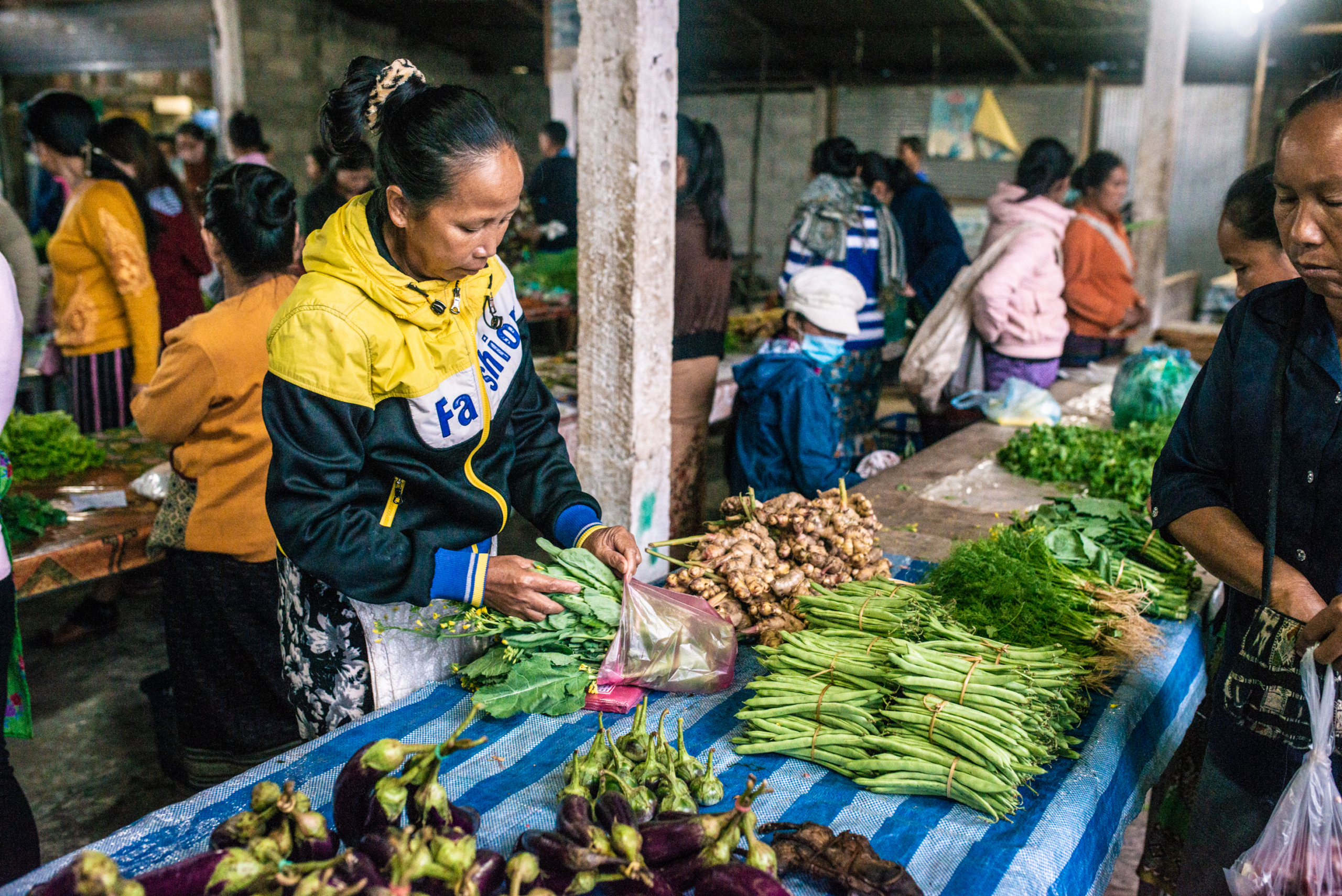
Card payment remains limited to certain businesses: hotels, restaurants, shops and agencies, mainly in the larger towns. For markets, small businesses and rural areas, carry cash; some merchants also accept QR payments. Ask which methods are accepted before ordering or booking.
A business may add a card surcharge: ask about the amount before paying. Bring a Visa or Mastercard, plus a second card from a different bank kept somewhere else.
QR payments: visitors can use them too
If you see a Lao customer pay for noodles by scanning a laminated card, you are not imagining it: QR payment is very common. Visitors can use it without opening a Lao bank account, through a suitable app.
- BCEL’s EzyKip lets you top up a wallet with a compatible international card and pay supported QR codes. Check top-up fees and the terms for refunding any remaining balance.
- LOCA Pay lets you pay participating QR codes with a compatible card or wallet, without a prepaid balance. On 11 September 2026, its published fee is 3% + 5,000 kip per transaction; check it before confirming.
Install the app before you need it and check registration requirements, card compatibility and your internet connection. Keep cash and small notes as a backup: no payment method works everywhere.
Changing money
You can change money at banks, at licensed exchange booths in town centres, and at the airport. A few markers:
- Compare the net amount you receive. On arrival, exchange enough for your first expenses, then compare rates and commissions at licensed providers.
- Dollars, baht and euros are among the currencies exchanged by major banks. Check which currencies and banknotes your chosen branch accepts.
- Notes must be in good condition. Torn, marked or old notes are refused, especially US dollars.
- Keep the receipt if you change a large amount.
Before you leave the country
Do not plan to exchange leftover kip once you get home. Reduce your balance before departure and ask about reconversion options in advance. The German Foreign Office guidance checked on 11 September 2026 states that importing and exporting kip is prohibited, and foreign currency must be declared from the equivalent of 10,000 USD. Before carrying a large amount, confirm the rules with the Lao authorities and those of other countries on your route.
What we tell our travellers
- Tell your bank your travel dates and ask for your weekly withdrawal ceiling to be raised.
- Two cards, stored separately, plus 100 to 200 USD in new notes.
- Group withdrawals around your needs and check the displayed fees.
- Stock up on cash before each rural leg, not after it.
- Choose to be charged in kip if you want your card network and bank to handle conversion.
On a trip with prepaid services, cash is mainly for personal spending, markets, tips and any meals or activities not included. Check the inclusions in your quote. That holds on a classic itinerary such as Nature and Culture of Laos as much as on a southern loop like the highlights of southern Laos. Your allowance depends on your purchases and any services not included; for the full cost of a trip, see our guide to budgeting a trip to Laos.
Frequently asked questions
How much cash should I bring to Laos?
A reserve of 100 to 200 USD in clean notes can be useful; euros are also exchangeable in the main towns. Withdraw kip locally and carry enough for each rural leg up to the next confirmed ATM. Check what is already included in your trip.
Can I use my credit card in Laos?
Some hotels, restaurants, shops and agencies accept cards, mainly in larger towns. Ask about acceptance and surcharges before paying. Elsewhere, carry cash or use a compatible tourist QR payment app where accepted.
What is the ATM withdrawal limit in Laos?
There is no single limit for every bank and machine. Check the amount and fee shown on screen, plus your own card limits. A branch cash advance has separate terms and should not be assumed to cost the same as an ATM withdrawal.
Are US dollars accepted in Laos?
Sometimes, in hotels and shops in larger towns, but at an unfavourable in-house rate. Prices are increasingly quoted in kip only. Pay in kip and keep dollars as a backup.
Planning a trip?
We are a Lao travel agency based in Vientiane, and we build every itinerary to order. If you are looking at the dry season, this is when the best addresses get booked. Write to us — we send an initial reply within 24 business hours, followed by a detailed proposal within 48 business hours after receiving the necessary information. These times are calculated on working days in Laos (UTC+7).