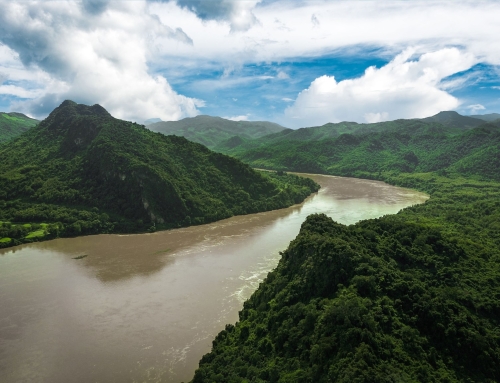

In the turbulent waters of the Nam Park River, on the border between Phongsaly and Oudomxay provinces, a fisherman from Ban Hadnang village casts his nets one morning in the 14th century. His net catches something at the bottom of the Vang Hom whirlpool. He dives. And there, resting on a rock slab as if on a throne, a bronze Buddha radiates a golden halo in the dark depths of the river. Thus begins the extraordinary story of the Pha Singkham—the “Golden Buddha”—which has watched over Muang La and the entire Oudomxay region ever since.
A Statue Born in Sri Lanka 2,400 Years Ago
The story of the Pha Singkham dates back more than two millennia. According to ancient texts engraved on palm leaves and preserved in the Vientiane library, the statue was cast in the subcontinent of Lanka—present-day Sri Lanka—approximately one hundred years after the death of the historical Buddha.
Legend tells that a group of monks, wishing to contemplate the face of the Master they had never been able to see, one day received a visit from a mysterious young man—the King of the Nagas transformed into human form. He promised them that if they prepared a sacred place, the image of the Buddha would appear there on the seventh day. The promise was kept: a luminous statue 144 cm tall appeared, emitting a blinding halo. The monks decided to reproduce it in bronze, using an alloy of three precious metals: Thonglad, Thongke, and bronze.
The statue received three names over time: Phra Sihing, Sihingabuddho, and finally Singkham, “fine gold.” It weighs approximately 200 kg, measures 144 cm in height, 54 cm wide at the chest, and 76 cm at the lap. Its right thumb, which remained detached during the original casting, was only repaired much later—in accordance with an ancient monk’s prophecy.
A 2,000-Year Journey Across Southeast Asia
For centuries, the Pha Singkham traveled from kingdom to kingdom. It resided successively in Cambodia, Ayutthaya (the former capital of Thailand), Kamphaengphet, and Chiang Rai, where 14 generations of rulers vied for its presence. In the year 868 of the Buddhist calendar, it finally arrived in the kingdom of Lane Xang, today’s Laos.
It was King Fa Ngum, in the 14th century, who gave the Pha Singkham its Lao destiny. After unifying the Lao kingdom, Fa Ngum undertook to place five sacred Buddhas at the four corners of the country to mark its spiritual borders. The Pha Singkham was entrusted to the commander of the left army, with the mission of taking it to Xieng Houng in Sipsong Phanna. The convoy traveled up the Nam Park River by pirogue.
The Discovery in the Nam Park Whirlpool
But fate decided otherwise. At the Hom whirlpool—Vang Hom—enemies attacked the convoy. In the battle and confusion, the pirogue sank. The Pha Singkham disappeared into the depths of the Nam Park River, on the border between Muang Khoua (Phongsaly) and Muang La (Oudomxay).
Decades later, a fisherman from Ban Hadnang village, named Sene Souak, took his nets and cast them into that same Hom whirlpool. The net caught. He dove and discovered the statue, seated on a rock slab, intact, as if guarded by the King of the Nagas. The news spread like wildfire through all the valleys of the Nam Park and Nam Ou.
Villagers from across the region attempted to raise the statue. In vain. They tried with ropes braided by each household—one hundred fathoms each. Nothing. It was finally seven Khmu families from Ban Lanh village, at the foot of Mount Phou Lingkoy, who succeeded where all had failed. They braided a ritual rope of one hundred fathoms, made of three elements: green grass, black rice stalks, and black and red widow’s thread. Reciting prayers in the Lao Theung language, they dove, bound the statue, and pulled. It rose to the surface.
The Miracle of the Boat and the Arrival at Muang La
A new dispute then erupted between Muang Khoua to the south and Muang La to the north: who would have the right to keep the Pha Singkham? The two communities decided to defer to the will of the Buddha himself. They placed the statue in a boat in the middle of the whirlpool and prayed: if it drifted south, it belonged to Muang Khoua; north, to Muang La. The boat traveled upstream—without a rower. The Pha Singkham was for Muang La.
The procession set out northward. But halfway, at the foot of Mount Phou Khao Khouay—the “Buffalo Mountain”—the bearers collapsed from exhaustion. It was impossible to take another step. The consulted diviner decided: this was where the Pha Singkham wanted to remain, at the confluence of the Nam La and Nam Park. This pass is still called Kiew Id, the “Pass of Exhaustion,” today.
The Temple of Phou Khao Khouay at Muang La
A shelter of wood and thatch was first built at the summit of Phou Khao Khouay to protect the statue. Gradually, a true pagoda took shape, built in the architectural style of the Leu people. In the year 2000 of the Buddhist calendar (1457 CE), the villagers erected a first stone worship hall with a central tunnel to house the Pha Singkham.
The temple suffered terrible destruction during the wars of the 20th century. For more than twenty years, the Pha Singkham was hidden in a cave to protect it from American bombing. After the liberation of the country in 1975, it was carefully restored and returned to its place. Reconstruction work spanned from 1987 to 2005, with the participation of generous Lao donors and the diaspora, including Deputy Prime Minister Somsavath Lensavat, who alone contributed 40 million kip.
Today, the Phachao Singkham Xayaram Temple stands on Mount Phou Khao Khouay, 28 km from Oudomxay town, where the Nam La and Nam Park rivers meet. It is a major pilgrimage site for the inhabitants of Oudomxay and the Nam Ou and Nam Park basins.
The Miracles of the Pha Singkham
The legend of the Pha Singkham is marked by wonders. During the reign of King Ounkham, Cheung invaders attempted to desecrate the temple: a storm suddenly struck, trees collapsed on them. During the Vietnam War, American planes targeted the temple—the bombs did not hit it. The inhabitants of Muang La also tell that on certain full moon evenings, the statue would disappear from the temple to join the Houay Lee cave, guarded by the Nagas, before reappearing at dawn.
Even today, the faithful come from across the region to ask for the protection of the Pha Singkham in case of illness or hardship, writing wishes on sheets of paper that they place before the statue.
How to Visit Muang La from Luang Prabang or Oudomxay
Muang La is a small peaceful town located in the heart of nature, on the banks of the Nam Park, 28 km southeast of Oudomxay. The journey from Luang Prabang takes approximately 3.5 to 4 hours by car along the Nam Ou River—a magnificent route in itself. From Vientiane, allow a full day by road or a flight to Oudomxay (approximately 1 hour).
Muang La is best known for its luxury riverside resort, its natural hot springs, and its treks to the surrounding Khmu villages—the direct descendants of the seven families who brought the Pha Singkham out of the waters. The temple is open to visitors year-round; the major annual festival takes place during the full moon of the 10th month of the Lao calendar.
Asia Safari regularly includes Muang La in its off-the-beaten-path Northern Laos tours. If you dream of discovering an authentic Laos, far from the tourist crowds of Luang Prabang, Muang La and its thousand-year-old Buddha await you.
Would you like to include Muang La in your trip to Laos? Contact us—our local guides know this region intimately and will prepare a tailor-made tour for you.
To Go Further
If your journey takes you to Northern Laos, combine your visit to the Pha Singkham Temple with the region’s must-sees. Here are some useful readings: Trekking in ethnic minority villages · Nong Khiaw and Muang Ngoi · Understanding Buddhism in Laos · Off-the-beaten-path Northern Laos tours.
Another legendary statue of Laos: the Phra Bang, the golden Buddha that gave Luang Prabang its name.